
 You may have noticed Feedjit has been promoting Bluehost during the last few weeks at the top of the live traffic feed. I decided to provide a link to a reliable hosting company because I’ve been approached by many of our publishers asking me exactly that question:
I need to upgrade my blog or website to handle growth, can you recommend a great web hosting company?
There are some specific reasons I recommend Bluehost as a blog and website hosting company, but first some background. I’m the founder and CEO of Feedjit. Our web applications are seen by over 200 million people every month and our site gets several million unique visitors every month. My company owns its own servers and they are based in our data center in Seattle. So I have a fair amount of experience in what it takes to run a high traffic web business and the difference between great infrastructure and not-so-great.
I’m also the founder of Wordfence which is a web security plugin for WordPress and is part of Feedjit Inc. Through Wordfence my team and I have had the opportunity to work with many hosting companies and we have found Bluehost to be professional and their platform to be realiable and the most problem free platform we’ve come across. Bluehost is particularly good at hosting WordPress blogs and websites – more on that below.
Lets get back to infrastructure for a moment. I want you to watch this Bluehost ad. It will give you some idea of the depth of experience Bluehost has with providing a solid hosting environment:
A few take aways from the video:
- Bluehost has developed a proprietary hardware platform that is tailored for maximum performance and fault tolerance. Few companies take this step and Google is one of them. It is a sign of a mature business with a deep knowledge of their field.
- Bluehost provides SSH access which most hosts don’t.
- On a shared hosting environment, whether you’re using virtual machines or not, there is a risk that one customer will hog resources from everyone else. Bluehost has developed a proprietary system that isolates performance hogs and prevents them from impacting other customers.
Incidentally, I chat regularly with James who appears in the above video, so those are all real employees.
The last bullet point above about shared resources is an important one because the impact of not having a host who can isolate performance bottlenecks is this: If your web application starts using a lot of resources and the host can’t isolate your resource hogging, the only course of action they can take is to suspend your account.
In my experience working with hosting providers, I’ve seen one very large web host in particular who’s default action is to simply suspend an account if it uses too many resources and to send you an email telling you your site is down. So the ability to isolate performance hogs doesn’t just protect you from having your hosting slow down when another customer hogs resources, but it can protect your account from simply being suspended every time your application usage spikes.
So why is SSH access important? The reasons are endless, but for my Wordfence team and I there is one major benefit: If we encounter a site with a possible security problem and we want to investigate, the first thing we ask for is SSH access to the server. SSH access allows us to use Linux commands to quickly do complex pattern searches on your server to find the source of an intrusion and what files they have infected.
Finally, the main reason I’ve decided to partner our business with Bluehost rather than another hosting provider is this: We have tens of thousands of customers who are WordPress publishers and who use products like our Wordfence security plugin. We constantly receive support emails and posts on our forums where there is clearly a compatability problem or other problem with the host that our customer is using. To date we have not received a single support request related to Bluehost. They seem to be able to provide the most solid hosting WordPress platform in the business.
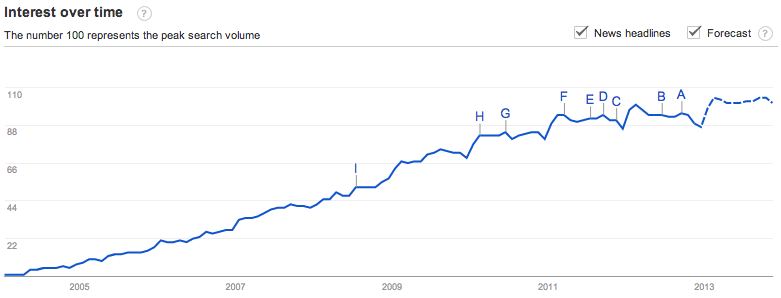
Why do we care so much about WordPress? Because it is the fastest growing and best publishing platform on the Web. I’ve embedded a graph from Google Trends that will give you some idea of how fast WordPress has grown. So if you’re looking for great WordPress hosting, Bluehost is where you want to base your site. Here’s the Google Trends graph and I’ve included a dotted forecast which shows projected growth in WordPress for the next year.
If you click a link on this page and go to Bluehost to sign up, Feedjit receives a commission from the sale. This helps us to continue to provide the free Live Traffic Feed to our customers. Thanks for your support!
Happy hosting!
Mark Maunder
Feedjit Founder & CEO
Wordfence Founder.

Today we completed a major systems upgrade to Feedjit at our data center just outside Seattle. We managed to do this without any service interruption.
You’ll notice that your live traffic feed and our website in general is now more responsive than ever.
The upgrade took a total of 8 hours to complete and touched many of our internal hardware and software systems. Thanks to the redundancy we have built into our physical and logical systems, we managed to complete the work without any interruption to our website or applications.
We hope you’ll continue to enjoy the worlds most popular live traffic feed and our other products like Wordfence.
Regards,
Mark Maunder
Feedjit Founder & CEO.
Today we released a simple but valuable plugin for our WordPress bloggers and site owners. It’s called simply “Benchmark” and you can find it on the WordPress repository or by signing into your WordPress website and doing a search on the word “Benchmark” on the “Add New” plugin menu.
The plugin is free, open source and is simply a way to find out how fast your WordPress website is compared to other sites.
It benchmarks your CPU and memory, network speed and database queries per second. It then shows you how you compare against the industry average.
This is something we’ve wanted ourselves for some time now, so why not make it free for everyone.
Enjoy!
Just a quick note to announce that Feedjit Inc. has launched Wordfence which is a security plugin for WordPress. Wordfence is free and you can get it for your WordPress site by following these steps:
- Sign in to your WordPress website.
- Hover over the “Plugins” menu and click “Add New”.
- Enter “Wordfence” in the search box.
- Install Wordfence and you’re all set.
You can visit the Wordfence Forums by clicking here.
You can also find Wordfence on the WordPress.org plugin repository.
Welcome to Issue #55 of The Weekly Feed. The Weekly Feed is published approximately once a week when we have news, information and helpful tips to share.
Three days ago Google launched and update that may radically affect the amount of search engine traffic your blog or website gets. They’re calling it a minor update to their algorithm, but it has already had a major effect on some sites. 8 Days ago I mentioned on Hacker News that a site that was scraping the popular StackOverflow was ranking higher than them – by republishing their content. Well Google has updated their algorithm and the scraper site’s traffic immediately plummeted by about 90%. The day-over-day drop is 40%. I’m not a fan of sites that steal content, but ouch!!

Here is Matt Cutts, head of Google’s anti-spam team making the announcement a few days ago.
From industry buzz it seems that Google is going after two kinds of sites this year. The first is sites that scrape content from others and republish that content unmodified (scraper sites). The second is sites who have low quality content farms, where large numbers of low wage humans generate low quality content purely to try and attract search engine traffic. We’ve now seen hard evidence of the new anti-scraper policy but not much evidence of Google going after content farms.
If you run a blog or content site that relies on SEO traffic, here is how you need to react to this:
- Make sure you limit the amount of republished content.
- If you do republish content, make sure there is at least the same amount of original content on the same page to balance it out.
- Beware publishing large amounts of low quality content. We haven’t seen any evidence of penalties in this area yet, but trust me they’re coming.
I’m also modifying my back-link strategy slightly:
Google has always had a duplicate content penalty but over the last few years scrapers have gotten good at getting around that by mixing and matching content and adding just enough of their own to have it appear unique to a machine. Now Google have made a few additional changes to their search algorithm to penalize scraper sites. The question is, what changes did they make?
My guess is that one of the things they are looking at is the number of “deep links” you have from other websites linking to content deep in your own site. Sites that scrape content tend to have many links from high ranking sites to their home page but few links to content deep in the site because people just don’t find the content valuable enough.
So one of the ways I’m reacting to this algorithm change is to make sure that it’s not just our home page that is linked to, but pages deep within the site too.
Expect to see a few more changes from Google like this as the year progresses. Remember, the most important thing is to have unique and useful content and to let the right websites know about it.
Lastly, Google just launched a service that you’ll hear about in the news tomorrow to help Egyptians stay in touch with the rest of the world as the government there removes Internet and Cellphone access. It’s called Speak2Tweet and it’s a collaboration between Twitter and Google. Here’s the quote from Google’s Blog in case you don’t have web access and are in Egypt:
“It’s already live and anyone can tweet by simply leaving a voicemail on one of these international phone numbers (+16504194196 or +390662207294 or +97316199855) and the service will instantly tweet the message using the hashtag #egypt. No Internet connection is required. People can listen to the messages by dialing the same phone numbers or going to twitter.com/speak2tweet.”
There are already some incredible messages being posted by Egyptians including this one referring to the million person march planned for tomorrow.
On a personal note, having lived through the transition of South Africa to a democracy, I’d like to wish any Egyptians who are Weekly Feed subscribers or Feedjit members a safe and influential week!
Best regards,
Mark Maunder
Feedjit Founder & CEO
Most of us don’t sell links designed to boost another website’s pagerank. But a many of us do exchange links with other websites and according to Google you can get penalized for “Excessive reciprocal links or excessive link exchanging (“Link to me and I’ll link to you.”)”. Recently Google has actively started penalizing websites for excessive link exchanging and link selling.
Several webmasters who run large sites have reported that they are receiving automated alerts via Google Webmaster Tools saying the following:
*snip*
Google Webmaster Tools notice of detected unnatural links on [domain]!
We’ve detected that some or all of your pages are using techniques that are outside our quality guidelines, which are available here.
Specifically, look for possibly artificial or unnatural links on your site pointing to other sites that could be intended to manipulate PageRank. For more information about our linking guidelines, visit this page.
We encourage you to make changes to your site so that it meets our quality guidelines. Once you’ve made these changes, please visit https://www.google.com/webmasters/tools/reconsideration?hl=en to submit your site for reconsideration in Google’s search results.
*snip*
Matt Cutts, a member of the Search Quality Group at Google has confirmed that Google is now penalizing sites who are selling links. Here’s the quote from a comment he posted on Webmasterworld:
“Yup, I believe that’s real. Remember at Pubcon I said we’d be ramping up our transparency when we think a site is outside our guidelines? This is one of those instances. The key part of this email is “Specifically, look for possibly artificial or unnatural links on your site pointing to other sites that could be intended to manipulate PageRank.” So one thing to look for is anything that could be considered linkselling, past linkselling, or that sort of thing.”
My advice to bloggers and webmasters is to consider very carefully if it’s worth exchanging links with a commercial website, even if that website is related to your websites subject matter and looks non-spammy, friendly and useful. If you have several links like this already, I’d recommend assessing each one using the following criteria:
- If the website you’re linking to engages in excessive link exchanging, remove the link.
- If the website has very little original content and lots of junk content they’ve scrounged from around the web and dumped on their site, remove the link.
- If they have excessive advertising or very agressive ads or affiliate programs, remove the link.
- If they have any other red flags like appearing on Google’s list of unsafe sites or McAfee’s list of bad websites, remove them.
The above list is simply my opinion and is a list of general heuristics that might indicate a site that could get you penalized, either because they are considered spam/dangerous by Google or because Google may bucket you as a link-exchanger site.
Remember that the best quality links, both incoming and outbound, are links that are organic and not reciprocal (not link exchanges). They are links that exist purely because someone found a resource on the web useful. While Google’s algorithm has changed over the years, they still rely heavily on the link structure of the web to find the best content. If you engage in link exchanges you are hurting their ability to find useful content. Recently you’ve probably noticed a lot more spam in Google’s search results. Google is now fighting this problem aggressively so expect to see more penalties for link manipulation and web spam.
Regards,
Mark Maunder
Feedjit Founder & CEO.
This week Facebook released data that is pure gold for marketers and publishers. Their Data Team took a dictionary created by the Linguistic Inquiry and Word Count project (LIWC) and analyzed 1 million status updates from US English speakers. The dictionary allowed them to categorize status updates into psychological and linguistic categories.
- Avoid referring to yourself or talking about yourself
- Talk about others and the social processes that occur between other people
- Stay positive, happy and up-beat.
- Don’t use bad language.
- If you want comments, ask your readers for them by using inclusive pronouns that encourages “cognitive process” - words like ‘think’, ‘opinion’, etc.
- If you want lots of friends, use social language and write longer blog entries, comments or updates that talk about other people rather than yourself.
We have rebranded The Daily Feed to The Weekly Feed. We’ll be publishing the newsletter once a week from now on usually at the beginning of the week.
If you, like me, have left your holiday shopping until the last minute, you’ve probably paid a visit to the Apple store recently. I’m in Colorado right now and paid a visit to the Park Meadows Apple store to get something I didn’t really need but that made a good excuse to give Steve more of my money.
A few minutes later I walked into the Microsoft store. I’ve managed to get over the fact that they cloned Apple the same way I don’t mind that Pepsi cloned Coke. Hey, competition is good for all of us. The experience was basically the same but the details were different and there were so many of them it was startling:
The store employees weren’t smiling, there were less of them and it was hard to get their attention. I wanted to buy Windows 7 and the price was $200 and the sales guy told me that “sorry, but that’s what it costs” even though I bought a new licensed copy (also the full install) on eBay this morning for $117. When the attendant swiped my card for my PC game he had to reach under a table and use a non-portable swiper. They didn’t offer me an email receipt or even take my email address. They assumed I wanted a paper receipt so that’s what I got. The guy who helped us had this look on his face like we weren’t supposed to be there.
The Apple store on the other hand was friendly, portable card swipes, email receipts, the store was packed and about 1 in 5 people were super helpful Apple employees. I stood in the wrong line (for the genius bar) and a guy came up to me and offered a checkout without making me feel like I’d screwed up. It was awesome and it’s the reason we own more Apples at Feedjit than PC’s for the first time this year.
Apple is big on the details of the impression they leave you with. Note the Apple Keynote Cutdown video. Not a single cut is repeated in that video. Business insider has a blog entry today about how Apple refers to it’s products grammatically as person’s and not as objects.
All these little touches add up to a whole that has far more marketing power than the sum of it’s parts. When you are thinking about your blog or website, take note of the details. Load times, color scheme, unpleasant distractions, how long you take to reply to your comments or respond to customer requests, the tone and language you use, how you moderate your comments, forums or wiki. All these details add up into a complete user experience and they all matter a whole lot.
Our news roundup for today:
Royal Pingdom published some revealing data today. They did a survey of a handlful of popular blogging platforms over 2 months to see which provide the best uptime. Blogger, WordPress and Typepad came up on top with Tumblr performing terribly. Tumblr had a total of 47 hours of down-time over a 2 month period. You can read the full report here.
Thomas Weber has a guide in The Daily Beast today that shares how he cracked the New York Times “Most Emailed” story list and got his story to #3 on the list. Thomas and his team figured out that the TImes counts individual senders per story. After 1,270 individual (volunteer) senders had emailed a story they made it to number 3 on the overall list. The times gets roughly 30 million visitors per month, and it takes around 1 in every 25,000 readers to email a story to get that story on to the top 10 most emailed story list.
And finally, if you’re in the Northern Hemisphere tonight at 12:41 Mountain Standard Time, enjoy the Lunar Eclipse. The Feedjit founders will be watching it at 7000 ft from Colorado.
Happy Holidays!!
Mark Maunder
Feedjit Founder & CEO
Quick note that we are renaming The Daily Feed to The Weekly Feed to reflect the frequency we have been publishing our newsletter.
This week I turned off Google instant, not because I don’t like living in an instant world, but because it limits my search results to 10. If you’re doing any kind of SEO research, 10 results just doesn’t cut it. There’s a bug that causes Google to continually show 10 results even if you asked it for 100 using advanced search. It’s caused by Google instant and you need to turn it off to get back to all you can eat search results.
In other news, a well known white hat hacker (that means he’s mostly a good guy) was detained for several hours when re-entering the US this week while his laptop and cellphone was confiscated and searched. I did some googling and it turns out that the border search exception lets border agents ignore the 4th amendment which requires a warrant for search and seizure. Then a member on ycombinator’s hacker news replied to a post of mine saying that in fact the border extends 100 miles inland. If you’re a blogger on the coast relying on anything in the 4th amendment, good luck with that.
Every now and then the government does actually get it right. The BBC is reporting that global spam email is down 47% after a combination of government arrests of spammers and work by private firms to shut down spam botnets.
And finally, a Reddit member got back to their apartment and found their pizza eaten by their roommate with this note waiting for them (click it if your browser shrinks it).

Regards,
Mark Maunder
Feedjit Founder & CEO