
Posts For: February 4, 2015
Abbas and Charlie Hebdo: More Hypocrisy
Last month, Palestinian Authority leader Mahmoud Abbas was, along with Israeli Prime Minister Benjamin Netanyahu, a prominent participant in the Paris unity rally after the Charlie Hebdo massacre and the slaughter at a kosher market. At the time, I noted the immense hypocrisy in having a figure who has engaged in Holocaust denial and who has also, even in the last few months, engaged in anti-Semitic incitement participate in such at an event. But weeks later we are learning that the disconnect between the symbolism of Abbas’s visible role in that unique moment and what he and his government are doing is even greater than we thought.
Last month, Palestinian Authority leader Mahmoud Abbas was, along with Israeli Prime Minister Benjamin Netanyahu, a prominent participant in the Paris unity rally after the Charlie Hebdo massacre and the slaughter at a kosher market. At the time, I noted the immense hypocrisy in having a figure who has engaged in Holocaust denial and who has also, even in the last few months, engaged in anti-Semitic incitement participate in such at an event. But weeks later we are learning that the disconnect between the symbolism of Abbas’s visible role in that unique moment and what he and his government are doing is even greater than we thought.
As today’s New York Times reports, Abbas has punished an editor of a PA publication that printed a cartoon that some readers thought might depict the Prophet Mohammed.
Mr. Abbas said it was necessary to take “deterrent measures against those responsible,” Wafa reported. Ali Khalaf, an editor at the newspaper, Al-Hayat al-Jadida, said on Tuesday that the cartoonist and the editor in chief of the paper had been suspended.
The cartoonist, Muhammed Sabaaneh, claimed that his drawing was meant to depict a Muslim who follows the message of Islam, not to depict the prophet himself. It was instead, “a symbolic figure for Islam and the Muslim’s role in spreading light and love for all humanity.” But if he thought that sort of thing would be accepted in a Palestinian media that routinely publishes articles and cartoons that demonize Jews and Israel, he was mistaken.
Of course, this isn’t the only indication that Abbas’s participation in the Parisian kumbaya moment was a farce. Weeks later, his Fatah Party issued a call for more “resistance” against Israelis, a code word for violence, and a hint that most Palestinians generally don’t need. Last fall, when Abbas and the PA incited Palestinians to attack Israelis in retaliation for the efforts by a few Jews to obtain equal prayer rights on the Temple Mount, there was no shortage of volunteers. For their pains, Abbas praised one attempted murderer as a “martyr” who went straight to heaven.
Why is Abbas pandering to such base sentiments? The answer came in part from a survey conducted in January by the Palestinian Ma’an News Agency which revealed that 84 percent of those queried believe that Israel was behind the Paris attacks rather than Islamist terrorists. While deplorable, this is hardly surprising since, as Palestine Media Watch notes, the official PA press has been filled with articles claiming this to be the case. In fact the same paper that Abbas punished for publishing the supposedly offensive cartoon ran a piece claiming that Israel benefited from the crime and therefore must be held responsible for it.
That the PA is responsible for incitement is nothing new. Nor is this the first Abbas (currently serving the 10th year of a four-year term as president of the PA) has been directly involved in dictatorial behavior. But what is remarkable about this is the fact that those who celebrated Abbas’s participation in the Paris rally and lionize him as a genuine partner for peace have nothing to say about his post-march behavior.
Yet these incidents are significant, not because they demonstrate Abbas’s hypocrisy or the moral bankruptcy of the PA kleptocracy over which he presides. Rather, they are important because they illustrate that the pose of moderation that he puts on for the Western press and American and European consumption has nothing to do with the way he governs the West Bank. Those who continue to push for a revival of a peace process that Abbas has continually snubbed and blown up after his repeated refusals of peace offers must ignore the truth about him. If they acknowledged the reality of Abbas’s conduct it would compel them to admit how wrongheaded their assumptions about Palestinian intentions and Israeli culpability for the lack of peace truly are.
UKIP’s Selective Democracy and the Jews
A major reason for the skepticism regarding the future of European Jewry is that there appears no political solution on the horizon to the worsening climate of anti-Semitism. The belief among many is that while it’s beyond dispute that the European left has failed the Jews, the European far right would fail them too if given the chance. And now UKIP, Britain’s ascendant right-wing populists, are proving the point.
A major reason for the skepticism regarding the future of European Jewry is that there appears no political solution on the horizon to the worsening climate of anti-Semitism. The belief among many is that while it’s beyond dispute that the European left has failed the Jews, the European far right would fail them too if given the chance. And now UKIP, Britain’s ascendant right-wing populists, are proving the point.
UKIP (the UK Independence Party) is actually far more moderate than its reputation would suggest. And unlike in France, it’s conceivable that an anti-EU party in Britain could pull the UK away from the union. That’s because Britain isn’t in the union with both feet. And it’s also because mainstream parties like the Conservatives have a strong and eloquent faction of Euroskeptics among them.
UKIP, in other words, gets a bad rap. Unfortunately, they’re starting to live up to it.
What’s concerning about the rise of the French far right is that a militant anti-Muslim posture, aside from being animated by discriminatory ideas, will do no good for non-Muslims either. You can’t have religious freedom for only some of your citizens and still be free.
UKIP is demonstrating this with its new anti-halal campaign.
The latest controversy started with the revelations that hidden cameras in a halal slaughterhouse had captured “horrifying” abuse of the animals before and during the slaughter. Muslims have been fighting against the government’s preference that animals be stunned before being slaughtered, and this appears to have turned public opinion back against them.
UKIP responded by calling for a ban on any slaughter in which the animal isn’t stunned first, in essence simply removing the religious exemption. As other similar bans have shown, this would outlaw the kosher shechita process as well. UKIP’s attempt at reassurance to Britain’s Jewish Chronicle sounded as though a Tory plant had dressed as a UKIP minister and set about sabotaging the group’s standing:
A senior Ukip member has claimed that the party’s ban on non-stun slaughter, announced today, was against his wishes.
MEP Stuart Agnew, the party’s agricultural spokesman, said: “We are a democratic party and I couldn’t get enough support. They didn’t like my tolerance of non-stunning.
“They have decided to override me on this occasion. I’m not going to say they were wrong.”
But Mr Agnew said the policy was not meant to target shechita.
“This isn’t aimed at you – it’s aimed elsewhere – it’s aimed at others.
“You’ve been caught in the crossfire; collateral damage. You know what I mean.”
Yes, we know what you mean. And that statement is a bumbling masterpiece.
First, the UKIP spokesman said that he was forced to go along with the outlawing of basic tenets of Judaism and Islam because they “are a democratic party.” I don’t know if he appreciated the irony of defending the proposal that the government stomp on individual rights in the name of democracy, but it’s not comforting.
His second part of the “defense” of the UKIP vote was more honest. The Jews are simply “collateral damage.” It’s possible he meant this in a positive way too, something like: You folks are usually the target of populist authoritarianism, so in a way you’ve graduated.
He might be comparing Britain to France here. Maybe UKIP thinks that because they’re not threatening violence, outlawing Jewish practice in this way is not the really bad kind of authoritarian nationalism. But in fact it’s not really fully accurate to say they’re not threatening violence, is it? After all, such laws are backed up by the force of the state, so we’re not talking about simply peer pressure here.
We’ve seen similar efforts in the U.S. get struck down by the courts, if they even get that far. For a while “anti-Sharia” laws were all the rage, but they often amounted to unconscionable infringements on religious liberty. (In one case an anti-Sharia law raised fears it would, as written, outlaw Jewish divorce.)
In Britain’s case, UKIP’s selective democracy works against the Jews twice over. Not only must Jews’ religious liberty be eroded because UKIP votes on its asinine schemes, but Jews are also not present in high enough numbers to make UKIP pay at the ballot box–or, at least, not in high enough numbers to stop a ritual slaughter ban from being a net-gain for UKIP:
Mr Agnew said he believed that the policy was put forward to win votes ahead of the general election.
He said: “There are more votes to be gained, and I expect that’s what they were looking for.
“We’ll have lost the Jewish vote for sure, they won’t support us now for sure – we won’t get any now.
“But we might gain votes elsewhere – and that’s what they’re after, general election votes.”
This is a perfect example of what a glorious document our Constitution, with its attendant amendments, is. Britain has a tradition of freedom and republicanism from which we get our own. But that tradition here was, wisely, codified and made explicit. UKIP’s members like to think of themselves as a party geared toward liberty. But it’s clear they don’t know the meaning of the word.
When Republicans Engage in Speculation from the Fever Swamps
In a March 2013 COMMENTARY essay Michael Gerson and I authored, we wrote this:
In a March 2013 COMMENTARY essay Michael Gerson and I authored, we wrote this:
Republicans need to harness their policy views to the findings of science. This has been effectively done on the pro-life issue, with sonograms that reveal the humanity of a developing child. But the cause of scientific literacy was not aided during the recent [2012] primary season, when Michele Bachmann warned that “innocent little 12-year-old girls” were being “forced to have a government injection” to prevent the spread of the human papilloma virus, adding that some vaccines may cause “mental retardation.” Bachmann managed to combine ignorance about public health, indifference to cervical cancer, anti-government paranoia, and discredited conspiracy theories about vaccines into one censorious package.
It looks like Chris Christie and, especially, Rand Paul are picking up where Ms. Bachmann left off. In an interview, Doctor Paul said, “I have heard of many tragic cases of walking, talking normal children who wound up with profound mental disorders after vaccines.” The ophthalmologist, after stinging criticisms of his statements, made an effort to backtrack from them. “I did not say vaccines caused disorders,” Paul insisted, “just that they were temporally related. I did not allege causation.” Of course you didn’t. Just sayin’.
It might be easier to give the Kentucky Republican and libertarian more of the benefit of the doubt if he had not previously argued that mandatory vaccines were a first step toward “martial law.” One day it’s vaccines for measles; the next day it’s Tiananmen Square.
The claim that there’s a link between “profound mental disorders”–Senator Paul clearly has in mind autism–and vaccinations has long ago been shattered. (The link was asserted in a 1998 article in The Lancet by the British doctor Andrew Wakefield; it has since been completely discredited. This excellent Wall Street Journal editorial is worth reading in this context.)
This kind of fever swamp speculation will hurt Senator Paul’s reputation, which is fine by me. It’s no secret I’m not a particular fan of his. But let me tell you what does concern me about this kind of talk from Paul, as well as from Governor Christie, who earlier this week echoed sentiments he expressed in a 2009 letter he sent to potential voters in which he said he had “met with families affected by autism,” many of whom had “expressed their concern over New Jersey’s highest-in-the-nation vaccine mandates. I stand with them now, and will stand with them as their governor in their fight for greater parental involvement in vaccination decisions that affect their children.” This has the effect of making the GOP look like the party of the benighted.
When probable Republican presidential candidates give voice to conspiracy theories–when they speak in ways that strike most people as bizarre and disturbing–it damages their party. In saying this, I understand that vaccinations won’t be a key issue in 2016. And a week from now, unless other Republicans make the same mistake (and to their credit it looks like most will not), the issue will die down.
But these kind of stumbles do considerably more harm, I think, than many people realize. They can break through in a way that, say, a substantive policy speech (or a dozen) does not; and in doing so they can feed a negative, even toxic, impression about a party and a political movement. Voters who don’t follow politics all that closely, when they hear stuff like this, come away thinking, “This must be the home of cranks and kooks.” Thanks to Rand Paul in particular, that charge is harder to refute than it was.
So let me conclude with a modest suggestion: Prominent Republicans–especially those who are interested in winning the GOP’s presidential nomination–should, for reasons having to do with epistemology and politics, conduct themselves in a manner that demonstrates that Republicans are at peace with, not at war with, science and medicine.
The Roots of ‘Crazy’ in the Middle East
When it comes to bizarre and buffoonish behavior among leaders in the world, Kim Jong-un might be the leader of the pack, but the talent is deep in Middle East: Muammar Gaddafi would rant and rave. His UN speeches were feats of endurance for the audience as much as for Gaddafi himself. He surrounded himself with female bodyguards and his physical transformation rivaled only Michael Jackson. Gaddafi’s son Hannibal was a chip off the old block: After he and his wife beat two servants in a Swiss hotel, they arrested him. The resulting vendetta culminated with Gaddafi calling for a jihad against Switzerland.
When it comes to bizarre and buffoonish behavior among leaders in the world, Kim Jong-un might be the leader of the pack, but the talent is deep in Middle East: Muammar Gaddafi would rant and rave. His UN speeches were feats of endurance for the audience as much as for Gaddafi himself. He surrounded himself with female bodyguards and his physical transformation rivaled only Michael Jackson. Gaddafi’s son Hannibal was a chip off the old block: After he and his wife beat two servants in a Swiss hotel, they arrested him. The resulting vendetta culminated with Gaddafi calling for a jihad against Switzerland.
Qaddafi, of course, was not alone. Saddam Hussein might have been evil, but he was not crazy: he was cold, calculating, and ruthless, but he was positively sane next to his eldest son Uday Hussein. Uday’s exploits are well-known: He was a rapist, murderer, and psychopath. When Iraq’s national soccer team lost a game, he would beat them. Torture was for him an amusing game.
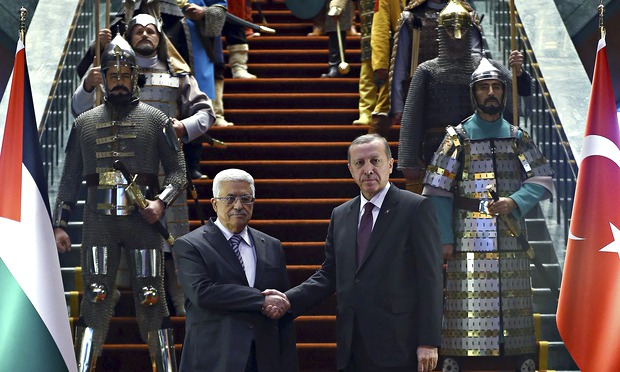
President Recep Tayyip Erdoğan has inherited Gaddafi’s mantle for the flamboyant and bizarre. He is unrepentantly corrupt, thin-skinned, and conspiratorial. Whereas many rulers can be dictatorial and/or adversarial, Erdoğan increasingly seems simply unhinged.
The Saudi royal family is notoriously cloistered, but some of the princes are hardly bastions of virtue behind the scenes. A single Saudi prince killed 2,100 endangered birds while on vacation in Pakistan. Heck, taking a vacation to Pakistan is hardly evidence of sound mind. And other Saudi royals stand accused of worse.
Even in Iraqi Kurdistan, normally thought of as an oasis of stability, there is quite a lot of crazy. Former President Jalal Talabani effectively exiled his eldest son Bafil to London as his behavior grew erratic, and Kurdish President Masoud Barzani’s eldest sons Masrour and Mansour are giving Uday’s reputation a run for its money. Not everyone would consider attacking a family rival in a Virginia dentist’s office wise, and even fewer would act on their impulse.
Why is it that the Middle East has become not only a region of dictatorships, but also a region of crazy? Under Saddam there was a joke about the sycophancy and the infallibility of rulers: Tariq Aziz was giving a press conference in which a reporter asked him whether elephants could fly. He answered “Of course not,” but then another journalist pointed out that Saddam said elephants could fly. Without missing a beat, Aziz said, “Ah, yes, but only very slowly.” In such a situation, Erdoğan has become Saddam’s successor as the master of flying elephants; no journalist would tell the sultan he has no clothes lest his newspaper be closed and he or his family imprisoned.
There are other reasons as well, especially when it comes to the children. As open and democratic as some leaders claim their countries to be, family remains paramount. Rulers surround themselves with sycophants who affirm their every move. To have been a Gaddafi, Barzani, or Saudi from the right line was to never have to say sorry. There were two sets of rules, mutually exclusive: That of the country and society and that of the family. Countries were mere playgrounds where even the most horrific abuse could be covered up with money. Money, power, and fame can be a volatile combination when mixed.
Leaders like Gaddafi and Barzani might consider themselves great thinkers or statesmen, but they tend to be poor fathers, allowing their children to grow up surrounded by servants who cater to their children’s every need and confuse respect for the leader with absolute deference to the child. Limits are arbitrary and ephemeral, and morality optional.
There is no hard-and-fast rule, and of course the individual matters. Qusay may have been bad, but he was not Uday; Qubad has not followed in Bafil’s footprints; and for every Saudi prince who becomes a psychopath, there are dozens who are merely massively spoiled.
An oddity of the odious is an obsession with Hollywood. Kim Jong-un, for example, is famously obsessed with Hollywood. First Lady Asma al-Assad pow-wowed with Brad Pitt and Angelina Jolie. King Abdullah II of Jordan doesn’t fit the same moral mold, but he is a dictator—and a notorious trekkie. Perhaps, then, a good analogy to the crazy infusing the Middle East are Hollywood’s child stars. Being famous young and surrounded by sycophants has famously taken its toll on some child stars but not all. For every Lindsay Lohan there is a Mayim Bialik; and for every Macaulay Culkin there is a Ron Howard. Culture, upbringing, and values matter.

How tragic it is then that beyond war, terrorism, and potential recession, so much sycophancy, corruption, and impunity has transformed so many current and next generation leaders in the Middle East to the political equivalent of the cast of Different Strokes.
Friedman Spreads Anti-Semitic Libels About Netanyahu Speech
The stakes are growing in the debate about the wisdom of Israeli Prime Minister Netanyahu’s decision to accept an invitation to address a joint session of Congress about sanctions on Iran. Though the argument can be viewed as just one more spat promoted by an administration with an axe to grind against Netanyahu, with the talk of Democrats, even Vice President Biden, prepared to boycott the event because they see it an as an effort to aid Republican efforts to discredit President Obama’s foreign policy, the potential for real damage is no longer theoretical. But the most troubling development is not the ongoing arguments about whether the prime minister has committed a blunder. Rather, it is the willingness by some to use it to stoke anti-Israel libels. That’s the upshot of the latest column from the New York Times’s Thomas Friedman who claims Netanyahu’s speech will be seen as an attempt to force the U.S. into a war with Iran. That is not only a gross distortion of the truth but also a not-so-subtle effort to plant the seeds of an anti-Semitic libel.
The stakes are growing in the debate about the wisdom of Israeli Prime Minister Netanyahu’s decision to accept an invitation to address a joint session of Congress about sanctions on Iran. Though the argument can be viewed as just one more spat promoted by an administration with an axe to grind against Netanyahu, with the talk of Democrats, even Vice President Biden, prepared to boycott the event because they see it an as an effort to aid Republican efforts to discredit President Obama’s foreign policy, the potential for real damage is no longer theoretical. But the most troubling development is not the ongoing arguments about whether the prime minister has committed a blunder. Rather, it is the willingness by some to use it to stoke anti-Israel libels. That’s the upshot of the latest column from the New York Times’s Thomas Friedman who claims Netanyahu’s speech will be seen as an attempt to force the U.S. into a war with Iran. That is not only a gross distortion of the truth but also a not-so-subtle effort to plant the seeds of an anti-Semitic libel.
Supporters of the speech, such as Wall Street Journal columnist and COMMENTARY contributor Bret Stephens, argue that Congress needs an “unvarnished account of the choice to which Mr. Obama proposes to put Israel: either accede to continued diplomacy with Iran, and therefore its de facto nuclearization; or strike Iran militarily in defiance of the U.S. and Mr. Obama’s concordat with Tehran.” I don’t disagree, but as I have written in the last two weeks, I think the decision to give the speech was a grave tactical error on Netanyahu’s part. Congress was in no doubt about Israel’s position and the prime minister could have reached out to members in the same way that British Prime Minister David Cameron has used to back up the president. But by parachuting directly into the debate on Iran sanctions that is taking place in Congress, he ran the risk of being seen as trying to upstage the president in a way that was bound to ruffle the feathers of many pro-Israel Democrats, even those that agree with Netanyahu on the issue. The proposed speech also provided Obama with a heaven-sent chance to divert attention from the administration’s indefensible opposition to strengthening their hand in the nuclear talks with Iran. The prime minister’s alleged chutzpah became the focus of the discussion instead of the president’s clear desire for détente with the Islamist regime, dealing sanctions proponents a clear setback.
But Friedman, who is at least smart enough to seem to harbor some doubts about whether Obama’s diplomacy can succeed, isn’t satisfied with asserting that Netanyahu is making the mistake. Instead, he uses this controversy to return to one of his favorite hobbyhorses: the way pro-Israel political donors, such as billionaire Sheldon Adelson, are trying to buy Congress in a way that runs contrary to U.S. interests. Claiming, without backing the charge up with reporting, that Adelson hatched the idea is one thing. He even says someone should have told Netanyahu and Israeli Ambassador Ron Dermer “anti-Semites, who claim Israel controls Washington, will have a field day.” The fact that it is Friedman who has floated this charge in the Times when he complained about the ovations Netanyahu earned the last time he addressed Congress is unmentioned in the column.
Even worse, Friedman then goes on to write that if diplomacy fails and the U.S. is forced to use force to address the Iranian threat, the Netanyahu speech will serve as a smoking gun proving that it was Israel that manipulated America into what might prove to be another disastrous war.
Of course, Friedman frames this as helpful advice intended as advocacy for what is in Israel’s best interests. But by raising the specter of anti-Semitism as well as of what must be considered nothing short of a potential blood libel, Friedman is tipping his own hand.
One can agree with President Obama’s absurd belief that Iran must be appeased on the nuclear issue in order to help it “get right with the world” without raising the specious charge that opponents of this policy who think it will endanger the West as well as Israel are being bought by Jewish money. One can also envision what is at this late date a highly unlikely scenario in which Iran’s refusal to accept Obama’s offers—which would effectively give a Western seal of approval to the Islamist regime becoming a nuclear threshold state—might lead to armed conflict without dropping the hint that the Jews will be the ones who started it.
Yet Friedman can’t avoid those temptations and injects the virus of anti-Semitism into a debate about whether the president is really interested in carrying out his 2012 campaign promise to eliminate Iran’s nuclear program. By writing of anti-Semitism when virtually no one outside of the fever swamps of the far left and far right are doing so, Friedman is, once again, seeking to tilt the discussion in ways that do exactly what he claims he wishes to avoid.
Though President Obama has sought to paint advocates of more sanctions as warmongers, the truth is just the opposite. More sanctions that would actually press Iran to give up its nuclear toys are, in fact, the only path to successful effort to halt the threat from Tehran by measures short of war. Though it is hard to imagine a president so intent on normalizing relations with Iran ever considering the use of force, if that ever happened in this administration or his successor, it would be the result of the Islamists courting such a conflict, not Israeli political maneuvering. Iran’s ballistic missile program also means stopping it from going nuclear is as much a matter of U.S. security as the safety of Israel.
Anti-Semites need no prompting from Tom Friedman to promote libels against the Jewish state. But by seeking to frame the argument about Netanyahu as one that would justify their ravings, Friedman has crossed a line that no responsible journalist should even approach. Neither Netanyahu nor the pro-Israel community should hesitate to speak up for fear of giving anti-Semites ammunition. The prime minister’s plan to speak may be a tactical blunder but it is the willingness of Friedman to engage in this sort of incitement that is the real disgrace.
Charting the Arc of Obama’s “Jayvee Team”
“A former deputy director of the CIA said on ‘CBS This Morning’ Wednesday that it would take 100,000 ground troops to effectively respond to the Islamic State of Iraq and Syria, or ISIS. ‘Unless the coalition is willing to put more ground troops into Iraq and possibly into Syria, there is very little we can do to respond,’ said CBS News senior security contributor Michael Morell, the former No. 2 at the CIA [under President Obama]. Morell made the comments following ISIS’ release of a video Tuesday purportedly showing captive Jordanian pilot Lt. Muath Al-Kaseasbeh being burned to death. The killing led Jordanian officials to execute two Iraqi al Qaeda-linked prisoners.” — “Fight against ISIS needs troops to be effective, Michael Morell says,” CBS News, February 4, 2015
“A former deputy director of the CIA said on ‘CBS This Morning’ Wednesday that it would take 100,000 ground troops to effectively respond to the Islamic State of Iraq and Syria, or ISIS. ‘Unless the coalition is willing to put more ground troops into Iraq and possibly into Syria, there is very little we can do to respond,’ said CBS News senior security contributor Michael Morell, the former No. 2 at the CIA [under President Obama]. Morell made the comments following ISIS’ release of a video Tuesday purportedly showing captive Jordanian pilot Lt. Muath Al-Kaseasbeh being burned to death. The killing led Jordanian officials to execute two Iraqi al Qaeda-linked prisoners.” — “Fight against ISIS needs troops to be effective, Michael Morell says,” CBS News, February 4, 2015
* * * *
“The United Arab Emirates, a crucial Arab ally in the American-led coalition against the Islamic State, suspended airstrikes against the Sunni extremist group in December, citing fears for its pilots’ safety after a Jordanian pilot was captured and who the extremists said had been burned to death, United States officials said Tuesday.” — “United Arab Emirates, Key U.S. Ally in ISIS Effort, Disengaged in December,” New York Times, February 3, 2015
* * * *
“ISIS is going on the offensive in areas of strategic importance for the ISF [Iraqi Security Forces] and Iranian-backed militias to deny such forces freedom of movement between Samarra and its environs and the eastern Anbar front.” — “Iraq Situation Report,” The Institute for the Study of War, February 2, 2015
* * * *
“The Islamic State of Iraq and al-Sham (ISIS) has begun to expand its presence in the Syrian central corridor which stretches from the Jordanian border through Damascus to the central cities of Homs and Hama. The ‘central corridor’ is highly-contested key terrain for both the Syrian regime and its armed opposition, while ISIS presence has generally been limited in the area until recently… Over the past two months, ISIS has once again escalated its military and public relations activities in this area, threatening to divert both regime and rebel resources away from active fronts in the Damascus area in order to contend with the ISIS threat. This development may provide an indicator of ISIS’s broader expansion plans in western Syria and the potential response of Syrian opposition fighters to this expansion” — “The Islamic State Eyes Expansion in Damascus,” The Institute for the Study of War Syria Update, January 20, 2015
* * * *
‘“The analogy we use around here sometimes [in describing ISIS], and I think is accurate, is if a jayvee team puts on Lakers uniforms that doesn’t make them Kobe Bryant,’ Obama said, resorting to an uncharacteristically flip analogy. ‘I think there is a distinction between the capacity and reach of a bin Laden and a network that is actively planning major terrorist plots against the homeland versus jihadists who are engaged in various local power struggles and disputes, often sectarian.’” — President Obama, quoted in the New Yorker, January 27, 2014
Stop Debating Terminology; Just Defeat the Enemy
When I worked at the Pentagon as a low-level functionary a decade ago, I sat in on a meeting with a senior official who was ruminating about what to call insurgents in Iraq. Calling those fighting Americans “insurgents,” he argued, bestowed too much legitimacy on the group. Hence, the term “anti-Iraqi forces” was born. Some writers picked up on the “newspeak” and rightly dismissed it as a distraction, albeit one that represented hundreds of man hours before its first utterance. Labeling Iraqi insurgents “anti-Iraqi forces” did absolutely nothing to bring about their defeat.
When I worked at the Pentagon as a low-level functionary a decade ago, I sat in on a meeting with a senior official who was ruminating about what to call insurgents in Iraq. Calling those fighting Americans “insurgents,” he argued, bestowed too much legitimacy on the group. Hence, the term “anti-Iraqi forces” was born. Some writers picked up on the “newspeak” and rightly dismissed it as a distraction, albeit one that represented hundreds of man hours before its first utterance. Labeling Iraqi insurgents “anti-Iraqi forces” did absolutely nothing to bring about their defeat.
Alas, the pattern continues. I have sat through numerous lectures in which scholars and military officers warn against the term “jihadist” to describe those who wage violent jihad. (And, yes, throughout much of Islamic history, jihad was understood to mean violent holy war, not simply internal struggle as some theological revisionists contend.) The Council on American Islamic Relations (CAIR), a Muslim Brotherhood-oriented group and advocacy organization popular with the White House, has suggested banning the word “jihadist” and simply call those waging violent jihad “criminals” instead. This New York Times op-ed went so far as to suggest that by using the term “jihadists,” Americans were effectively endorsing their mission just as much as “if Franklin D. Roosevelt had taken to calling Adolf Hitler the ‘leader of the National Socialist Aryan patriots’ or dubbed Japanese soldiers fighting in World War II as the ‘defenders of Greater East Asian Co-Prosperity Sphere.’”
Ultimately, the George W. Bush administration agreed, and sought to ban government officials from using both “jihadists” and “mujahideen.” Its logic?
U.S. officials may be “unintentionally portraying terrorists, who lack moral and religious legitimacy, as brave fighters, legitimate soldiers or spokesmen for ordinary Muslims,” says a Homeland Security report. It’s entitled “Terminology to Define the Terrorists: Recommendations from American Muslims.” “Regarding ‘jihad,’ even if it is accurate to reference the term, it may not be strategic because it glamorizes terrorism, imbues terrorists with religious authority they do not have and damages relations with Muslims around the world,” the report says.
This, of course, is nonsense. Islamists no more look to the United States government to bless what is or is not Islamic than they would defer to the theological opinion of the owners of a Wiccan pig farm. If forced to decide what Islam justifies, Islamists will listen to a radical imam or their recruiter, not an anodyne U.S. Department of Homeland Security report.
Debates over the term “terrorism” are their own circle of hell. Homeland Security Secretary Janet Napolitano got off to a rocky start when she referred to terrorism as “man-caused disasters.” She explained:
“I referred to ‘man-caused’ disasters. That is perhaps only a nuance, but it demonstrates that we want to move away from the politics of fear toward a policy of being prepared for all risks that can occur.”
Sometimes moral equivalence infuses the debate. Terrorism, after all, can be judgmental term. Hence the BBC banned the use of the word “terrorist” to describe the perpetrators of last month’s massacre at the headquarters of the French satirical journal Charlie Hebdo. The head of BBC Arabic explained:
“Terrorism is such a loaded word. The UN has been struggling for more than a decade to define the word and they can’t. It is very difficult to. We know what political violence is, we know what murder, bombings and shootings are and we describe them. That’s much more revealing, we believe, than using a word like terrorist which people will see as value-laden.”
The problem is that redefining the word “terrorist” or omitting it from the lexicon altogether no more eliminates the problem of terrorism any more than Secretary of State Madeleine Albright’s decision to transform “rogue regimes” into “states of concern” transformed North Korea or the Islamic Republic of Iran into liberal, progressive, peace-loving utopias.
Enter the debate about the Islamic State. On September 10, 2014, President Obama cast dispersion on the term “Islamic State”:
Now let’s make two things clear: ISIL is not “Islamic.” No religion condones the killing of innocents. And the vast majority of ISIL’s victims have been Muslim. And ISIL is certainly not a state. It was formerly al Qaeda’s affiliate in Iraq, and has taken advantage of sectarian strife and Syria’s civil war to gain territory on both sides of the Iraq-Syrian border. It is recognized by no government, nor by the people it subjugates.
Secretary of State John Kerry has likewise said that the Islamic State is neither “a state nor truly Islamic,” and his French counterpart Laurent Fabius joined in to, advising against referring to the Islamic State as either Islamic or a state, the former because it offends Muslims and the latter because it bestows too much legitimacy. The Pentagon, of course, didn’t want to be left out of the wordplay games. It urged its personnel to use the term Daesh. Lt. Gen. James Terry, commander of the U.S. effort in Iraq and Syria, explained:
“Our partners, at least the ones that I work with, ask us to use that, because they feel that if you use ISIL, that you legitimize a self-declared caliphate. … They feel pretty strongly that we should not be doing that.”
The Boston Globe made much the same argument. Here’s the problem: Daesh is simply the Arabic acronym for al-Dawla al-Islamiya al-Iraq al-Sham which literally means the “Islamic State of Iraq and Syria.” So, all the Pentagon fuss is the equivalent of saying the word “duck” is offensive to the French, so use “canard” instead.
White House political operatives love their polls just as the Pentagon embraces its metrics. Perhaps the biggest indicator of success or failure against external threats, however, is the inverse relationship between defeat of the enemy and a desire to debate terminology. Debate about what to call the Islamic State doesn’t advance its defeat one nanosecond. It is nothing more than a distraction—one that costs lives by substituting political correctness for progress and bureaucratic machination for battlefield success.
Rand Can’t Inoculate Himself Against Vaccine Flap
In his four years since winning a Kentucky Senate seat, Rand Paul has labored long and hard to establish an identity that would cause voters to see him as both smarter and less extreme than his father Ron. Up until this last week, he had largely succeeded as he expanded upon the libertarian base Ron Paul had built and, though the increased concern about ISIS and terrorism has undermined his appeal, added new fans that liked his stands against administration policy. But all that hard work may come to nothing because of his statement about vaccination. Paul may have thought he was just venting some standard libertarian suspicion about government involvement in heath care on Monday when he said vaccination should be a matter of individual choice for parents and that he had heard from parents who believe the shots were responsible for “profound mental disorders” in their children. But the comments may do more harm to his 2016 presidential hopes than the ocean of ink that has been spilled by those seeking to point out the flaws in his views on foreign policy.
In his four years since winning a Kentucky Senate seat, Rand Paul has labored long and hard to establish an identity that would cause voters to see him as both smarter and less extreme than his father Ron. Up until this last week, he had largely succeeded as he expanded upon the libertarian base Ron Paul had built and, though the increased concern about ISIS and terrorism has undermined his appeal, added new fans that liked his stands against administration policy. But all that hard work may come to nothing because of his statement about vaccination. Paul may have thought he was just venting some standard libertarian suspicion about government involvement in heath care on Monday when he said vaccination should be a matter of individual choice for parents and that he had heard from parents who believe the shots were responsible for “profound mental disorders” in their children. But the comments may do more harm to his 2016 presidential hopes than the ocean of ink that has been spilled by those seeking to point out the flaws in his views on foreign policy.
Paul appears to be furious about the way his remarks have been interpreted and has repeated that he personally supports vaccination. He even offered to have a New York Times reporter accompany him to get a Hepatitis A booster shot. But, unlike the problem that New Jersey Governor Chris Christie created for himself earlier this week when he, too, made some remarks about “choice” with respect to vaccination, this can’t be easily spun away. As our John Podhoretz wrote today in the New York Post, that mistake could have been the result of a mistaken political instinct to avoid giving offense to those who are opposed to vaccines. I also believe it is the natural result of his predilection for shooting from the hip, a characteristic that has both built his reputation as a straight shooter but also inevitably leads to gaffes.
But Paul’s problem is not an example of a politician foolishly expanding on remarks when he should just stick to bland statements of fact. His beliefs about vaccination and government, not to mention his willingness to air unsubstantiated scare stories about the side effects of vaccines, illustrates a basic flaw in the Kentucky senator’s political makeup. Great leaders like Ronald Reagan were able to tap into voter mistrust of intrusive big government in order to articulate a vision of a country where individual initiative could prevail. But Paul’s beliefs are rooted in a dark, conspiracy-filled world in which government is not just a problem but also the enemy.
Republican primary voters got a taste of this anti-vaccination lunacy in the 2012 cycle when Michele Bachmann touted her opposition to the HPV vaccine as part of an effort to undermine the tottering campaign of Texas Governor Rick Perry who had supported the effort to get teenagers inoculated. Bachmann’s citation of anecdotal evidence that this vaccine had terrible side effects discredited her candidacy. Now Paul, with the unwitting assistance of Christie, has stepped onto the same land mine.
Though Paul is treating the focus on his views as a liberal media conspiracy, the concern about vaccines wasn’t hatched in the fertile imagination of a biased press corps. The outbreak of measles that originated in Disneyland has brought to the forefront an issue that has been percolating on the margins for years. A growing anti-vaccine movement promoted by celebrities has peddled bogus science about the shots causing autism or other disorders. This has led to a decline in vaccinations that has given new life to preventable diseases that most Americans had stopped worrying about.
It’s all well and good for people like Paul to try to apply libertarian principles that, in other contexts, all Americans should embrace, to a wide variety of topics. But when it comes to public health, an individual’s right to avoid vaccines impinges on the rights of the community to raise their children without fear of deadly diseases that were believed to be on the brink of extinction not long ago. It’s one thing to talk of the imperative of individual freedom when it comes to a nationalized health-care scheme such as ObamaCare that imposes decisions on individuals and companies and prevents them from making the choices that make sense for them. The same is true with respect to education issues such as school choice and the right to home school kids. We may all agree that, as Paul said, “The state doesn’t own your children. Parents own the children.” But to apply that belief to an effort to support those who are creating what may eventually prove to a far greater threat to public health than Ebola or some other exotic disease is another thing entirely.
Paul’s statements are significant because, unlike Christie’s foolish comments, they weren’t gaffes but rooted in longstanding beliefs. Much is being made today of Paul’s membership in a doctor’s group that, among other things, has publicized discredited medical theories aimed at undermining public support for vaccination. But rather than harp on his membership, which may have lapsed when he entered the Senate, we should be thinking long and hard about the way his views on this issue reflect a profoundly disturbing view of the world.
Paul has been able to distinguish his own wildly inconsistent foreign-policy views from those of an extremist like his father who views American power as a force for evil in the world. His ability to perform that trick was an act of political genius, especially when you consider that he has always supported his father’s positions in the past. Isolationism or a neo-isolationism that Paul has falsely dubbed a new “realism” can appear defensible in the context of past American blunders abroad. But by defending outlier extremists who are endangering the lives of other citizens because of their bizarre beliefs about medicine or organic food, Paul has planted his feet firmly in extremist territory. Indeed, in doing so he has made the most extreme of his potential rivals for the 2016 presidential nomination—Dr. Ben Carson—look like a model of moderate common sense.
Vaccination may not remain an important issue in the coming year and it would be foolish to dismiss Paul’s chances altogether. But the memory of Paul’s stand will linger. If his once promising campaign ultimately fizzles, we may look back on this controversy as the moment when he started slipping back into the margins where his father always dwelt.
On the Death (and Life) of Martin Gilbert
Early in my career in Jewish journalism, I was working on a column about the ideological considerations of interwar Zionists’ appeals to Western leaders. Winston Churchill obviously figured in this story, and so I knew immediately the best person to reach out to for input: Martin Gilbert. His response to that inquiry always stuck with me, and it’s only added to the sadness of the news today that Gilbert has passed away.
Early in my career in Jewish journalism, I was working on a column about the ideological considerations of interwar Zionists’ appeals to Western leaders. Winston Churchill obviously figured in this story, and so I knew immediately the best person to reach out to for input: Martin Gilbert. His response to that inquiry always stuck with me, and it’s only added to the sadness of the news today that Gilbert has passed away.
I emailed Gilbert my question. He responded with a warm note and emailed me a digital copy of a page of his manuscript for his book Churchill and the Jews. The book was already published (indeed it was already in paperback), so he could have referred me to the book. Had he wanted to be even more helpful, he could have given me a page number. But he sent me the page from the manuscript that he thought might be of the most help to my column in part because the page had his own notes on it. He was giving me not just the finished copy, but the thought process that led to it.
A few things struck me about the exchange. The first was that Sir Martin Gilbert, Churchill’s official biographer, had essentially volunteered to do my research for me. The second was that I had never met nor spoken to Gilbert before that, so it wasn’t as though he was taking this effort for a friend. Then I realized just how generous he must be with actual friends and colleagues.
But far more important for Gilbert’s legacy was what it said about his approach to historiography. Martin Gilbert had a rare combination of intellectual ambition and personal humility. On an issue related to Winston Churchill and also to the events leading up the founding of the State of Israel–two monumental subjects of the 20th century–there was absolutely no question that Gilbert was the man to ask. That is an accomplishment in itself.
It was made more impressive by the fact that Gilbert was very good at his job. Anyone seeking to understand the 20th century simply couldn’t avoid relying to varying degrees on the path Gilbert set. For example, among just the books currently sitting on my desk next to me are Gilbert’s one-volume biography of Churchill, his history of Israel, his history of the 20th century (another anthology that was also released as a single-volume edition), and two volumes he edited: one of Churchill’s speeches and writings, and the other a historical atlas of the Arab-Israeli conflict.
Gilbert wrote a history of the Holocaust, a modern history of Jerusalem, and a history of the Jews living under Islamic rule, and he was the editor of Churchill’s papers. The higher the mountain, in other words, the more eager Gilbert was to climb it.
Gilbert’s books also had defining characteristics. For one, his books eschew the Western trend of self-flagellation while still remaining fully faithful to the historical record. They don’t drown in guilt and don’t whitewash either. For another, Gilbert’s humility found its way into his books.
One example of this is in his introduction to the Churchill biography. The great man lived a well chronicled life, and anyone writing a book on Churchill faces a similar question asked of American historians seeking to write about Abe Lincoln: What could you possibly add to the historical record?
For Gilbert, this was less of a problem because he had begun his work early on, while Churchill was still alive. He had less of a need, at least at the outset, to self-consciously distinguish himself. It was those who followed the path he cleared who had to do so. But he also made it clear that he took his job to be a historian first and foremost and thus he did not pretend to know his subject better than his subject knew himself. Gilbert allowed Sir Winston’s voice to remain more prominent than his own:
The record of Churchill’s life is a particularly full one, for which a vast mass of contemporary material survives. It is therefore possible, for almost every incident in which he was involved, to present his own words and arguments, his thinking, his true intentions, and his precise actions.
It may seem downright radical in this age of revisionism and reinterpretation, but Gilbert’s history was living history, not a lecture.
He was also willing to learn from his fellow historians. In reviewing Lucy S. Dawidowicz’s The Holocaust and the Historians for COMMENTARY in 1981, Gilbert opens with self-criticism. He notes that he had recently leafed through a new British biography of Hitler and was aghast at the shabby treatment of the Holocaust within its pages. But he said and did nothing else; he moved on. “Lucy S. Dawidowicz’s new book shows me how wrong it is to remain silent,” he writes, scolding himself for shirking a historian’s duty.
In reviewing Paul Johnson’s History of the Jews for COMMENTARY six years later, Gilbert treats his fellow historian’s work as a necessary corrective to the narrow lens through which many historians, himself included, view Jewish history. He writes that “what we now call the Holocaust has scarred, and will continue to scar, the Jewish consciousness, and will do so to such an extent that many students of universal Jewish themes, myself included, have already neglected, and will go on neglecting, the wider historical and cultural spheres for this one. It is for that reason as much as any that Paul Johnson’s new book is to be welcomed.”
This humility and sense of personal responsibility permeates Gilbert’s staggeringly accomplished career, and is one of the many reasons he will be sorrowfully missed and justly celebrated.
Jordan Chooses Sides
Kudos to King Abdullah II of Jordan for his decision to execute Sajida al-Rishawi, an Iraqi would-be suicide bomber who was part of a terrorist cell that carried out a suicide attack on three Amman hotels in 2005. The Jordanian government executed her and fellow terrorist Ziyad Karboli at dawn in response to the Islamic State’s brutal murder of Jordanian pilot Muath Al Kasaesbeh by caging him and then burning him alive.
Kudos to King Abdullah II of Jordan for his decision to execute Sajida al-Rishawi, an Iraqi would-be suicide bomber who was part of a terrorist cell that carried out a suicide attack on three Amman hotels in 2005. The Jordanian government executed her and fellow terrorist Ziyad Karboli at dawn in response to the Islamic State’s brutal murder of Jordanian pilot Muath Al Kasaesbeh by caging him and then burning him alive.
From a political perspective, the executions were necessary. The video of the execution was as brutal as it was scarring. It has circulated widely in Arabic chat forums and elsewhere online. Jordanians, who are already critical of their king, want action. To do anything but execute Sajida would be to hand the Islamic State (ISIS) a victory by effectively cowing to their demands that Jordan stand down. Frankly, she should have died years ago in order to bring justice for the families of her victims. The king demurred, however, effectively commuting her sentence in order to appease her supporters and, alas, in Jordan there are many. Her execution, however, underscores that King Abdullah II has recognized that in the battle against Islamist extremism, Jordan can no longer be neutral.
When it comes to the forces buffeting the region, Jordan has long been between a rock and a hard place. It is nearly landlocked, and is resource poor. At the height of the Arab-Israeli conflict, it was not easy to border both Israel and Iraq, perhaps the Arab world’s most rejectionist state. While King Hussein of Jordan welcomes Palestinian refugees and, unlike all his neighbors, actually granted them citizenship so that they could get on with their lives and contribute more fully to society, he faced a PLO-led coup attempt in 1970, which he barely beat back.
Still, while many in Washington consider Jordan a stable, reliable ally and a security partner, the kingdom has traditionally been a bit two-faced, although its diplomats and officials would say such duplicitousness was necessary to survive. After the liberation of Kuwait from Iraqi occupation, Jordan became the chief source of Saddam Hussein’s smuggling enrichment under the Oil-for-Food program, a policy from which both King Hussein and King Abdullah II seem to have benefited. In the days before Iraq’s liberation, Jordan undercut opposition to Saddam Hussein and, in the war’s aftermath, welcomed Saddam’s wife and daughter (and their stolen money). Simply put, Jordan traditionally has sought to appease all sides in a conflict and based its security in being friendly with everyone that threatened it, be they Israel and the Palestinians, Saddam’s Iraq and the United States, or post-liberation Iraq and the insurgents which fought it.
The Jordanian balancing act also extended to the battle between Islamists and secularists. As my American Enterprise Institute colleague and Jordan expert Tara Beeny noted last month, while Jordan traditionally sought to accommodate and co-opt Islamists rather than fight them, the terror designation of the Muslim Brotherhood by the United Arab Emirates (UAE), an important source of aid to Jordan, had led the king to follow suit, and crack down on the Islamic Action Front, as the Jordanian wing of the Muslim Brotherhood is known. On one hand, the UAE’s pressure and now the reaction to the Islamic State’s execution of its pilot have painted King Abdullah II into a corner, one which might hamper his ability to co-opt and contain the Islamic State. On the other hand, however, neutrality is not always a virtue. When facing an evil like the Islamic State—not only bordering it but also dealing with it within Jordanian borders—it sometimes pays to take sides. In the battle against Islamist extremism, Jordan’s decision to take a firm stand is better late than never.
Harvard’s Moment of Veritas
Last week, Lawrence H. Summers, the Charles W. Eliot University Professor and president emeritus of Harvard University, and former Secretary of the treasury, delivered a lecture on “Academic Freedom and Anti-Semitism” at Columbia University. He recalled that in 2002, when a petition circulated among the Harvard and MIT faculty and students, calling on universities to divest from companies doing business in Israel, he labeled the initiative “anti-Semitic in effect if not intent.” Last week, he said his 2002 assertion “seems to me to have stood up rather well,” and warned that the situation has gotten even worse: “It is my impression that there are more grounds for concern today than at any point since the Second World War”:
Last week, Lawrence H. Summers, the Charles W. Eliot University Professor and president emeritus of Harvard University, and former Secretary of the treasury, delivered a lecture on “Academic Freedom and Anti-Semitism” at Columbia University. He recalled that in 2002, when a petition circulated among the Harvard and MIT faculty and students, calling on universities to divest from companies doing business in Israel, he labeled the initiative “anti-Semitic in effect if not intent.” Last week, he said his 2002 assertion “seems to me to have stood up rather well,” and warned that the situation has gotten even worse: “It is my impression that there are more grounds for concern today than at any point since the Second World War”:
We live in a world where there are nations in which the penalty for homosexuality is death, in which women are stoned for adultery, in which torture is pervasive, in which governments are killing tens of thousands of their own people each year. But the proponents of Israeli boycotts, divestiture, and sanctions do not favor any form of pressure against countries other than Israel.
Summers asserted that the recent boycott of Israel by the American Studies Association (ASA) was “anti-Semitic in effect and quite likely in intent” (emphasis added), since it applied only to Israel, sought to demonize the Jewish state, and was “unrelated to the expertise” of the ASA. When you reach out, beyond your area of competence, to delegitimize the Jewish state–and none other–both the effect and intent of the action seem reasonably clear. Summers said that university presidents should have responded to the ASA by saying something like this:
“The decision of the American Studies Association supported by a majority of its membership to single out Israeli institutions and Israeli scholars for selective boycott is abhorrent. The University believes it is very dangerous for scholarly associations to insert themselves into political issues outside of their range of competence. While individual members of the faculty are free to do as they wish, the University is withdrawing its institutional membership in the ASA. We will withdraw from any scholarly association that engages in similar boycotts with respect to Israel or any other country.”
Summers also wrote an op-ed published in yesterday’s Harvard Crimson, expressing his growing concern about what he has seen at Harvard. Unlike many universities that withdrew from the ASA in response to its boycott, Harvard remains an institutional member. Summers’ concluding paragraph suggests that this is a moment of truth for Harvard, whose official motto is Veritas:
Harvard’s example has never been more important. If Harvard is to lead on academic freedom it is essential that we all feel free to assert our views but that our University protect with ferocity its reputation by preventing views demonizing Israel or any other country from being bestowed with its good name.
More than a decade ago, Summers’ description of advocates of divestment as “anti-Semitic in effect if not intent” generated more controversy than any other academic freedom issue during his entire five-year Harvard presidency. In 2015, it is not clear whether his Columbia lecture and Crimson op-ed will elicit any response at all from Harvard’s administration.
What does it bode for the future if things have declined so far that America’s oldest university (and once deemed its most prestigious) not only fails to lead, but chooses not even to follow the example set by other educational institutions–and continues to lend its imprimatur and prestige to an academic association whose action was not only anti-Semitic in effect but likely in intent as well?
(Hat tip: Ira Stoll, editor, Future of Capitalism.)
ISIS Stokes Sino-Japanese Antagonism
Beijing apparently believes in Rahm Emanuel’s famous dictum that you shouldn’t let a crisis go to waste. Instead of condemning ISIS’s brutal murder of two Japanese nationals, China’s propaganda arms are instead using the atrocity to caution the world against Japanese militarization. Nothing could better underscore the poisonous distrust between Asia’s two great powers, or more starkly illustrate the yawning gulf between them.
Beijing apparently believes in Rahm Emanuel’s famous dictum that you shouldn’t let a crisis go to waste. Instead of condemning ISIS’s brutal murder of two Japanese nationals, China’s propaganda arms are instead using the atrocity to caution the world against Japanese militarization. Nothing could better underscore the poisonous distrust between Asia’s two great powers, or more starkly illustrate the yawning gulf between them.
When the government-controlled Global Times opined that Japanese Prime Minister Abe would likely use the horrific murder as an excuse to send Japanese armed forces abroad, it was both revealing a deep-seated Chinese fear and seeking to further isolate Japan in Asia. Abe had indeed made very un-Japanese statements about making the terrorists pay, but that simply put him in league with Barack Obama, David Cameron, and Jordan’s King Abdullah. To the Chinese, however, Abe’s statements were in reality a dog whistle to right-wing nationalists that the Japanese military would finally be unleashed beyond Japan’s borders.
Such fantasizing is of course hogwash, not least because Japan has almost no offensive or power projection capability. Moreover, the still-powerful strain of pacifism in Japanese society has actually led many to criticize Abe’s plans for a greater Japanese role abroad as being too dangerous. China’s criticism instead says much more about Beijing’s worries than Japan’s intentions.
When Chinese officials look around Asia, they see only one country that could plausibly frustrate their desire to become the undisputed hegemon of the region. Despite having ten times the population, and having surpassed Japan in gross GDP, Chinese officials understand Japan’s continued strengths, its strong alliance with the United States, and its newfound willingness to reach out to other Asian nations to form partnerships. Given that China inspires growing worry over its military power and aggressive designs on disputed territory and common sea lanes alike, officials in Beijing know that the region is slowly adopting a balancing position against them. And Japan, especially under Abe, is the leader of that movement.
Thus, the vilification campaign. Instead of acknowledging Japan’s right to avenge its murdered citizens, and perhaps even offering support, China’s propaganda handmaidens seek instead to fan the flames of anti-Japanese feeling. Outside of China, this may well play the best in South Korea, where bilateral relations between Seoul and Tokyo are at their lowest level in decades, thanks in part to Abe’s ill-advised statements questioning sensitive World War II issues such as the comfort women or larger questions of Japan’s war guilt. For some of the antagonism between himself and his neighbors, Abe indeed deserves blame, but not for asserting that he will protect Japan’s interests.
What China is really telegraphing is far simpler: there will be no rapprochement between the two great powers anytime soon. And that means an Asia that continues to simmer with tensions both real and imagined.
Why Does Obama Ally with the RT Set?
Russia Today, now simply called RT, is Russia’s English-language broadcasting network. Among all the foreign satellite networks operating across the globe, RT and Iran’s PressTV are the most overtly propagandistic and anti-American. RT’s money comes from the Kremlin, and it follows Kremlin directives.
Russia Today, now simply called RT, is Russia’s English-language broadcasting network. Among all the foreign satellite networks operating across the globe, RT and Iran’s PressTV are the most overtly propagandistic and anti-American. RT’s money comes from the Kremlin, and it follows Kremlin directives.
As the German news magazine Der Spiegel explained:
…It is also meant to amplify the self-doubts of Europeans and Americans who have been forced by recent events to wonder if their own countries — like Russia and China — are corrupt and in the grip of a pervasive intelligence apparatus. In any case, the station has a rare knack for propaganda. The average age of the Russian editors is under 30, and almost everyone speaks fluent English. To spice up the news, directors sometimes use Hollywood-like special effects… There is also a logic behind such visual effects, especially since the station sees itself as a sort of ministry of media defense for the Kremlin.
And here is Foreign Policy listing in 2013 seven unbelievable RT segments, such as reporting that it was actually the FBI and not two radical Islamist Chechen brothers responsible for the attack. Progressives in the United States might bash Fox News, and conservatives might roll their eyes at MSNBC or CNN, but all the networks basically stick to the facts or host debates about the news; they do not simply make it up.
No matter what RT’s agenda, they would fail in their effort to project legitimacy if they did not host so many American guests. Every station has their favorite contributors or outside go-to experts. MSNBC, CNN, and Fox all have an array of former politicians, ex-diplomats, retired generals, columnists, and think tank experts to whom they turn. And, even if Fox skews right and CNN and MSNBC lean left, each will make an effort to include at least some people representing an opposing point of view.
What actually is quite curious, however, is RT’s choice of frequent commentators. The National Iranian American Council, for example, an anti-sanctions group which tends to lobby for the Islamic Republic’s diplomatic positions, constantly feeds the RT beast with guest appearance, both by Trita Parsi, its founder and president-for-life, as well as policy director Jamal Abdi and research director Reza Marashi. Barbara Slavin, a former journalist whose writing often advocates for Iranian positions, also talks to RT. Ditto Flynt Leverett, a former aide to Condoleezza Rice who now works full time to advance Iran’s narrative. Joseph Cirincione, who as head of the Ploughshares Fund channels money, is also part and parcel of the RT set. Colin Powell’s former chief of staff, Lawrence Wilkerson, often joins RT shows to bash the United States, its officials, and its policies. And the list goes on.
The irony here of course is that those who most affirm and lobby for Obama’s outreach for Iran—in Parsi and Ciricncione’s case often quite directly—never take stock of the fact that RT invites them because they affirm the Kremlin’s anti-American position. This shouldn’t necessarily surprise—Parsi has written in Internet chat forums that “There is no substitute for Iran!” What is surprising is that the Obama administration doesn’t take stock of the fact that the people who most embrace his policies and with whom he and his top aides sometime consult are those who never had the courage to walk off the RT set, who never stood up for the United States on the RT set, and whose writing seem infused with moral equivalence and a desire to see America lose.
What Is the U.S. Doing to Make Its Case in Iraq?
Bloomberg’s Eli Lake reports from Baghdad that the U.S. ambassador has flat out offered to coordinate U.S. air strikes with the Badr Organization, an Iraqi Shi‘ite militia trained and perhaps even directed by the Islamic Revolutionary Guard Corps. As Lake writes:
Bloomberg’s Eli Lake reports from Baghdad that the U.S. ambassador has flat out offered to coordinate U.S. air strikes with the Badr Organization, an Iraqi Shi‘ite militia trained and perhaps even directed by the Islamic Revolutionary Guard Corps. As Lake writes:
[Badr Organization leader Hadi al-] Amiri told me that late last month he met with U.S. ambassador Stuart Jones at his home, where the ambassador made the offer of U.S. air support to his ground campaign. “He told me, frankly speaking, ‘We are ready to offer back up in air strikes for the volunteers,’ ” Amiri said, using the term many militia leaders use to refer to the fighters under their command. Amiri said he thanked Jones for the offer, but told him he worried the U.S. Air Force could make a mistake and end up hitting his men instead of the Islamic State. When asked about the meeting, a spokesman for the U.S. embassy in Baghdad, Jeffrey Loree, told me: “We don’t confirm the details of our conversations. Our policy is that we support the ISF with air strikes and we have urged that the militias be under the command and control of the ISF.”
That’s bad enough, but it gets worse in a way that Lake did not address. Most Iraqis believe that the United States is not only responsible for the rise of the Islamic State (ISIS, ISIL, Daesh) but actively supports it. This is not the result of one or two conversations with Iraqis inside the Green Zone, but rather a pernicious belief that the majority of Iraqis harbor, in Kirkuk, Baghdad, Karbala, and presumably elsewhere.
The reason is simple: Iran. The basis of American influence operations is always to be truthful, and through truth build credibility. Iran has a different strategy, however: metaphorically to throw stuff at the wall and see what sticks. Just yesterday, Iranian Foreign Ministry official Hossein Amir Abdollahian called the U.S. fight against terrorism “insincere.” None other than the supreme leader has been preaching, here at a meeting of Islamic scholars, that the Islamic State is an American creation. Speaking about the rise of Islamist extremism in the Islamic State’s mold, Ayatollah Khamenei said:
…It is a few years now that it has been revived and strengthened with the plots of arrogance, with the money of some regional governments and with the schemes of the intelligence services of colonialist countries such as America, England and the Zionist regime… There is an undeniable point which is the fact that the takfiri orientation and the governments which support and advocate it move completely in the direction of the goals of arrogance and Zionism. Their work is in line with the goals of America, the colonialist governments in Europe and the government of the usurping Zionist regime. This movement is at the service of arrogance. It is at the service of America and England. What they do is at the service of the intelligence services of America and England. It is at the service of Mossad and other such intelligence services.
That may sound like the ranting and raving of a tired, old, paranoid dictator. But, alas, it has stuck, especially after one packet in an airdrop meant for the Kurdish resistance in Kobane went array and was recovered by the Islamic State.
The problem isn’t that the Iranian government actively spreads anti-American propaganda. That should be expected of a regime that, President Obama and Secretary of State John Kerry’s pronouncements aside, remains unrepentant. Rather, the problem is that the U.S. embassy in Baghdad remains silent. The embassy hosts hundreds of diplomats, but few get outside the blast walls surrounding the embassy complex, even to go elsewhere in the Green Zone. Rumors swirl, unrebutted by anyone in the U.S. embassy. Baghdad isn’t known for its security, but millions live outside the Green Zone, and diplomats from Iran, Turkey, and many other states regularly traverse the city. Even before Benghazi, guaranteeing diplomats’ security trumped any sense that they needed to circulate to do their jobs.
Security and effectiveness are always a precarious balance but they are no excuse for the United States to keep from being able to refute rumors and rebuff enemy information operations. There’s no point spending billions on an embassy if it is too afraid to function. That Iran gets away with blaming the United States for the Islamic State when Bashar al-Assad, Iran’s proxy in Damascus, refused for years to use his air force against the group as it grew and gathered strength in Raqqa says a lot about Iranian cynicism. Alas, that the United States refuses to make its case and allows Iranian lies to be the first draft of history says a lot about State Department’s incompetence.
February 2015
-
Articles
-
The Existential Necessity of Zionism After Paris
The Editors -
I Think That I Shall Never See a Jew As Lovely As a Tree
Tevi Troy -
The ‘Conversation About Race’ That Isn’t a Conversation
Noah RothmanTwenty years of talk about race obscures this country’s remarkable progress.
-
Slandering Americans Who Fight for Israel
Daniel FleschLone soldiers face unfounded accusations of unsavory origin.
-
The Return of North Korea
Michael Auslin -
Famous Actresses I Have Known
Frederic RaphaelA memoir, featuring Faye Dunaway’s cigarettes, Natalie Wood as Zelda Fitzgerald, and more.
Politics & Ideas
-
The Sage of Araby
Sohrab Ahmari -
Father Abraham
Jeremy Rozansky -
Choosing the Chosen
Stephen Daisley -
Uncoupling
Naomi Schaefer Riley
Culture & Civilization
-
WASP Without a Sting
Terry Teachout -
Madame Chaja
Jenna Weissman JoselitOn an exhibition about the little beauty giant Helena Rubinstein.
-
A Disaster of Biblical Proportions
David Wolpe -
Don’t Kill Us, We’ve Taken Sensitivity Training
Matthew Continetti
John Podhoretz
-
The Censors Win
John Podhoretz
Letters
-
Why Pasternak Dared
Our Readers -
What FDR Could Have Done for Jewish Children
Our ReadersResponses to “‘Children in Europe are Europe’s problem!’” by Robert Slayton
-
Ceding Europe to Extremists on Both Sides
Our ReadersResponses to “A Local Story of Global Jihad” by Annika Hernroth-Rothstein
Threat Assessment
-
Will Palestinians Be Held Accountable?
Jonathan S. Tobin
Enter Laughing
-