Writers' Archive
china
  • China operates the world’s most elaborate and opaque system of Internet censorship. But Congress, under pressure to take action against the theft of intellectual property, is considering misguided legislation that would strengthen China’s Great Firewall and even bring major features of it to America.

    The legislation — the Protect IP Act, which has been introduced in the Senate, and a House version known as the Stop Online Piracy Act — have an impressive array of well-financed backers, including the United States Chamber of Commerce, the Motion Picture Association of America, the American Federation of Musicians, the Directors Guild of America, the International Brotherhood of Teamsters and the Screen Actors Guild. The bills aim not to censor political or religious speech as China does, but to protect American intellectual property. Alarm at the infringement of creative works through the Internet is justifiable. The solutions offered by the legislation, however, threaten to inflict collateral damage on democratic discourse and dissent both at home and around the world.

  •  

          The words of truth are always paradoxical.

    Lao Tzu – Founder of Taoism


    The China we know today comprises the classic riddle wrapped inside an enigma. A commercial enterprise now stands in place of the People’s Revolution once championed by the Great Leader, Chairman Mao Tse-tung, exhibiting a rate of expansion that dwarfs the growth of any other nation in history. Much of that growth is the result of trade with the United States, which not only provided the capital, but also the expertise in the form of American-built factories and time-tested methodologies. Those global companies took advantage of the abundant cheap labor and growing local demand. China took everything else.

    In turning China into a capitalist state, we have become the victims of our own success. Our trade imbalance with China is debilitating to our domestic economy. Semi-skilled labor, already victimized by automation in this country, lost the bidding war against overseas competition as much due to the long-term ill will between unions and management as from the lowball bids and sweetheart deals available in China. Still, it was our loss and their gain.

    China manipulates its currency to an unheard of degree and practices obstructionist import policies, making our exported goods uncompetitive in their domestic markets. Chinese banks underwrite manufacturing exports to allow profit-taking from below-cost contracts. China uses our own technology against us, creating new breeds of super-computers with U.S.-made video accelerator chips, while directing their electronic spies to hack into our most sensitive databases. The need to reassess the status of our position with China is now forced on us. We may be left with no choice but confrontation. We might leave it to our government to go through the process of demonization and justification, which it feels is necessary in order to get us into a fighting mood. Since we are fairly well-educated as a nation, a simple examination of the facts should help and a brief history lesson is always a good place to start.

    Over the last hundred years or so of American globalism, the relationship with China reflects both its varied political forms and our specific global and domestic imperatives. During the Boxer Rebellion, President William McKinley ordered 5,000 American soldiers overseas (and by doing so, became the first president to undertake a foreign military venture without the permission of Congress) to protect the multi-national trade groups, diplomats and missionaries under siege from Chinese nationalists and elements of the Qing Dynasty.

    After the initial occupation of China by Japanese Imperial forces in 1937 and prior to U.S. entry in the Second World War, President Franklin Roosevelt secretly agreed to place American pilots, ground-support troops and planes at the disposal of the Republic of China’s leader, General Chiang Kai-shek. The personnel, formally relieved from active duty in the USAAF, and the aircraft, 100 Curtiss P-40s pared off from an RAF contract, formed the 1st American Volunteer Group, popularly known as the “Flying Tigers.” Under the guidance of Claire Chennault and with the unofficial sanction of U.S. political and military leadership, the AVG fought Japan on behalf of the Chinese government until reverting to U.S. command early in 1942.

    As the Second World War played out, a drama of a different sort was progressing in the Chinese political arena. The Japanese occupied Manchuria in the north (ruled by a puppet Chinese imperial government) and coastal port areas. Meanwhile, a combined force consisting of Chiang’s Kuomintang (KMT) Nationalists (the ruling party of the Republic of China) and the Communist Party of China (CPC) attempted to thwart Japanese incursions into the interior. The coalition, brought about when the CPC kidnapped Chiang and forced him to agree to their terms, held flimsily and, for the most part, ineffectively until tactical and ideological differences resulted in armed clashes between the two Chinese groups, beginning in 1941. At the conclusion of the Pacific war, the terms of surrender included the demand that Japanese forces remain in control of occupied Chinese territory until officially relieved by KMT troops. The CPC, given no standing by the international community, resumed the civil war it had waged for ten years prior to the Japanese invasion.

    At the end of the Second World War, all wary eyes turned toward the Soviet Union. Winston Churchill, once a lone voice warning of the global threat growing within Germany’s Third Reich, again took to the pulpit and preached about a darkness descending on the whole of Eastern Europe. This time, he did not stand alone. Western preoccupation with the U.S.S.R. in Europe allowed events in East Asia to slowly coalesce into the imbalanced form with which we are now familiar. By 1949, the Chinese Civil War was settled in favor of the CPC (with a good deal of help, in the end, from the North Korean government).

    By declaring the People’s Republic of China as a new Marxist state, Mao Tse-tung (or Mao Zedong, for the Standard Chinese interpreters among you) created a separate category of geopolitical considerations. Caught off-guard by the KMT’s collapse, Western governments, including the United States, reacted too late in the process to alter the balance of power within China. The defeated Kuomintang and their followers retreated across the China Strait to the island of Taiwan (known as Formosa before being ceded by the Japanese as war reparations) and reestablished a Republic of China government in Taipei. Outright possession of the island stood as a matter tied to the legal pretzel of several conflicting treaty agreements, while possession of the mainland remained the goal of the Kuomintang. The KMT continued to mount small-scale attacks against the Chinese mainland until 1979 and a technical state of war between the People’s Republic and the Taiwanese exiles continues to the present day.

    French Indochina tells a tale more convoluted than that of China’s internal drama, more complex than these few paragraphs will allow. Simply put, the conflict between French colonial rule and a Soviet-inspired “independence” movement, which lasted for five years after the end of WWII, represents the first large-scale “war-by-proxy” of the Cold War. The United States provided weapons and money (and eventually, limited naval and air support) to the French, the U.S.S.R. supplied money and advisors to the Vietnamese, and the People’s Republic (and the CPC before them) supplied the rebels with a majority of their weaponry. This standoff, in which a colonized people rose up against their colonial masters and left a nation literally divided, established the lasting precedent that ideology, at least as represented by the spread of Communism, trumped any long-held anticolonial sentiment in this country.

    More troubles brewed to the north. Korea, granted independence from Japan in accordance with the Cairo Agreement of 1943, quickly turned into a bargaining chip at Potsdam, where the United States and Great Britain conceded the northern portion of Korea to Soviet influence in exchange for considerations in Europe. Once again, we see Eurocentric minds creating untenable situations elsewhere. Two U.S. Army colonels chose the dividing line at the 38th Parallel, one of whom was Dean Rusk (who later served as Secretary of State for both the Kennedy and Johnson administrations and acted as international point man during the escalating U.S. involvement in Vietnam). The positioning of the border later proved a strategic blunder, placing it too far north for immediate reinforcement.

    At the war-time Cairo conference, as well as at Yalta and Potsdam, the negotiating parties gave no thought to the possibility of Chinese Communist intervention in Korean affairs. In fact, they gave little thought at all to Korea as a possible flashpoint. The main players considered China an ally, as well as a democratic nation (at least as democratic as a one-party government could be), albeit of minor importance. The expectation, especially after the Potsdam Conference in 1945, was of Soviet domination in Manchuria, checked by American and British strongholds in the Philippines, Japan, Malay and Hong Kong, along with friendly governments in China (including Taiwan) and South Korea. The Communist victory in China upset that balance, temporarily to the favor of the Soviets.

    When North Korean President Kim Il-sung approached Joseph Stalin in 1950, seeking Soviet support for a war of unification, the Soviet leader reacted favorably to the idea, but told the Korean that he could not support it publicly. Stalin advised Kim to bring his plan to the Chinese. The friendly relationship between the Korean and Chinese Communists dated back to the years they fought side-by-side in Manchuria against the Japanese. It was further strengthened by North Korea’s support during the Chinese Civil War. It seems natural now to infer that China felt beholden to Korea in promising support for their impending attack on South Korea. That Kim would move without the comfort of knowing a trusted ally had his back appears doubtful. It is quite possible that, by reason of logic, the Korean War would not have occurred when it did without China’s promised cooperation.

    The Truman administration initially considered U.S. intervention on behalf of South Korea worrisome for its potential to spread to Europe (once again looking backwards at the Soviets). The decision to act hinged partly on Korea’s proximity to Japan, along with the growing concern (finally!) of a complete Communist conquest of East Asia. Rather than act unilaterally, the United States pressed the United Nations Security Council to vote for U.N. intervention. Resolution 82 passed, thanks to a Soviet Union boycott of proceedings, due to the seating of Taiwan, rather than the People’s Republic of China, on the Council. The United States moved to assist South Korea under the U.N. flag, accompanied by token numbers of troops from throughout the free world.

    Moving forward, a back-and-forth struggle ensued, with the North Koreans pinning the South Koreans and the U.N. forces with their backs to the sea at Pusan. Reinforcements, along with a backdoor amphibious assault at Inchon, created several problems for both sides. During the initial assaults, China placed a quarter of a million troops at its border with North Korea. As the landing at Inchon took place, the Chinese advised Korea to withdraw from the vicinity of Inchon and retreat north, allowing U.N. forces to retake the South Korean capital in Seoul. Soviet advisors, under the direction of Stalin, advised the North Koreans to redeploy the forces still surrounding Pusan to defend against the incursion at Inchon. The resulting confusion resulted in an almost complete disintegration of North Korean forces in the south.

    Meanwhile, Truman issued a National Security memo expressly forbidding Theater Commander Douglas MacArthur from sending U.N. forces across the 38th Parallel if there was any sign of Soviet or Chinese intervention. However, with the North Korean army in full retreat, U.S. Secretary of State George Marshall provided MacArthur with his personal authorization to do so, regardless, thus countermanding a Presidential directive. U.N. troops followed the South Korean Army north, eventually approaching the Yalu River, which separated North Korea from China. It was MacArthur’s stated goal, despite Truman’s continuing orders for restraint, to cross into Chinese territory and destroy the supply lines feeding back into the North Korean forces. Before he could do so, Chinese troops crossed over and began a counter-offensive. During the extended fighting, U.N. forces retreated back below the 38th Parallel. The conflict turned into a war of attrition and ended with a negotiated truce. The two Koreas, like the two Chinas, remain in a state of war.

    One of the results of the clash of advice to the North Koreans was a growing rift between the People’s Republic and the Soviet Union. There were ideological differences, of course. Mao was an orthodox Marxist, while the Soviet system followed the Protestantism of Lenin. To us, they were Communists. To each other, they were the wrong kinds of Communists. As a nation, we were not yet sophisticated enough to appreciate, and take advantage of, the difference. Instead, we followed our Global Anti-Communist playbook to the letter and ended up knee-deep in the rice paddies of Vietnam.

    After the French gave up their claim to Indochina, Cambodia and Laos became independent nations, and Vietnam was partitioned at the 17th Parallel, in keeping with popular notion that by giving each ideology its own space, peace might reign. It did not. Another war-by-proxy ensued, but this time the Chinese sat it out. The South Vietnamese performed so poorly, despite receiving millions in weapons and aid, that the Johnson administration felt obligated to escalate U.S. involvement with the introduction of American ground forces. We know how that ended … as the most unpopular war in our history, to the everlasting detriment of the citizens who served in the armed forces during that period and to our nation’s prestige on the world stage. For once, China lay blameless. Let’s give them two points for that.

    Richard Nixon did. In 1972, he became the First U.S. President to visit China. The results of that visit are monumental. Fearing isolation, the Soviet Union broached détente with the U.S., the People’s Republic and the U.S. normalized diplomatic relations (at a cost of throwing Taiwan out of the U.N. and off the list of Presidential State Dinner invitations), and Red China finally took its place on the Security Council of the United Nations.

    In the intervening years, there have been clashes between India and China, the relationship with the Soviets remained cool through the collapse of their empire (and remains so with those mildly democratic Russians) and Taiwan continues to play the role of sticking burr. The last thing China wants right now (or at any time in the near future) is a major conflict with the United States. They have a strategy that is working, by worming slowly, almost unnoticeably, into our national body, creating conditions that leave us unable to resist their ultimate and total domination, perhaps sooner than any of us imagines.

    In the next part, we will look at the case for war with China, including plausible justifications, potential global trigger-points and endgame strategies, along with realistic best and worst-case scenarios. Stay tuned.


  • The Senate on Monday weighed whether to punish China for undervaluing its currency and taking away American jobs. At issue is whether legislation would boost the American economy, as its supporters argue, or initiate a damaging trade war with a major partner.

  • The ouster of West Bengal's Communist government after 34 years in power is no less of a watershed for having been widely predicted. For more than a generation the Party had shaped the culture, economy and society of one of the most populous provinces in India—91 million strong—and won massive majorities in the state assembly in seven consecutive elections. West Bengal had also provided the bulk of the Communist Party of India–Marxist (cpm) deputies to India's parliament, the Lok Sabha; in the mid-90s its Chief Minister, Jyoti Basu, had been spoken of as the possible Prime Minister of a centre-left coalition. The cpm's fall from power also therefore suggests a change in the equation of Indian politics at the national level. But this cannot simply be read as a shift to the right. West Bengal has seen a high degree of popular mobilization against the cpm's Beijing-style land grabs over the past decade. Though her origins lie in the state's deeply conservative Congress Party, the challenger Mamata Banerjee based her campaign on an appeal to those dispossessed and alienated by the cpm's breakneck capitalist-development policies, not least the party's notoriously brutal treatment of poor peasants at Singur and Nandigram, and was herself accused by the Communists of being soft on the Maoists.  (continue reading by the link above...)

  • Food insecurity, loss of food sovereignty, the displacement of small farmers, conflict, environmental devastation, water loss, and the further impoverishment and political instability of African nations – these are among the consequences of large-scale investments in land in Africa, a special investigation by the Oakland Institute has revealed. Pambazuka News spoke to Anuradha Mittal, Jeff Furman and Frederic Mousseau about what prompted their research and what they discovered.

  • By Andrew Gavin Marshall

    Introduction


    As the purported assassination of Osama bin Laden has placed the focus on Pakistan, it is vital to assess the changing role of Pakistan in broad geostrategic terms, and in particular, of the changing American strategy toward Pakistan. The recently reported assassination was a propaganda ploy aimed at targeting Pakistan. To understand this, it is necessary to examine how America has, in recent years, altered its strategy in Pakistan in the direction of destabilization. In short, Pakistan is an American target. The reason: Pakistan’s growing military and strategic ties to China, America’s primary global strategic rival. In the ‘Great Game’ for global hegemony, any country that impedes America’s world primacy – even one as historically significant to America as Pakistan – may be sacrificed upon the altar of war.


    Part 1 of ‘Pakistan in Pieces’ examines the changing views of the American strategic community – particularly the military and intelligence circles – towards Pakistan. In particular, there is a general acknowledgement that Pakistan will very likely continue to be destabilized and ultimately collapse. What is not mentioned in these assessments, however, is the role of the military and intelligence communities in making this a reality; a veritable self-fulfilling prophecy. This part also examines the active on the ground changes in American strategy in Pakistan, with increasing military incursions into the country.

  • Cold Fairyland

    Band Sites: http://www.myspace.com/coldfairyland

    Official: http://www.coldfairyland.com/


    Cold Fairyland, (冷酷仙境, Lěngkù Xiānjìng) is based in Shanghai, China. Their style combines Eastern melodies and rhythms with Western symphonic rock and classical music. These two sides allow them to play in concert halls as well as in rock clubs.

    Cold Fairyland was established in 2001 by LinDi (Vocals/Pipa/Keyboard) and Su Yong(Bass). They reworked several songs each had previously written and made a demo. Soon after it’s unofficial release online, it was picked up by an underground record company LStape and released on cassette. This demo later became available as their first CD “Flying Over the City”. Shortly thereafter drummer Li Jia joined the band. With the rest of it’s lineup still in a state of flux, CFL played it’s first show at a bar called NowhereTown. In September 2001, they played a cancer benefit at XinTianDi’s ARK Rock Club in Shanghai; thus began their long relationship with the club. They have played in many festivals and clubs across China, including The Beijing MIDI Music Festival, often referred to as the Woodstock of China.  CFL had  a rotation of guitarists until 2003, when they settled on Song Jian Feng, a MIDI device engineer who worked with Su Yong. Next to join in 2004 was the cellist known as Yao Yao (Zhou Shengan) from the Shanghai Opera. Xi JinE was added as a keyboard player in summer of 2008, and Seppo M. Lehto replaced Su Yong on bass guitar in August 2008.

    The name Cold Fairyland comes from a Chinese translation of one of Haruki Murakami's books (known in English as "Hard-Boiled Wonderland and the End of the World") favored by LinDi. The name reflects the sometimes dark tones of their music.

    Composer, arranger. keyboardist and pipa player LinDi has been playing pipa since she was 4 years old. Her arrangement skills often bring out very surprising elements from the mix of cello, pipa, keyboards, bass. drums and guitar.

    The Cold Fairyland Albums:

    1. Flying Over the City (2001)

    2. Ten Days in Magic Land (LinDi's solo album released in Taiwan 2002)

    3. Kingdom of Benevolent Strangers (2003)

    4. Bride in Legend ( LinDi's solo album released in Taiwan 2004)

    5. Live 2005 (2006)

    6. Seeds on the Ground (2007)

    7. Meet in Secret Garden ( LinDi's solo album released in 2009)

    In 2008, Cold Fairyland signed with TreeMusic Records of Beijing, who republished “Seeds on the Ground” and released “2008 Cold Fairyland Tour in Finland DVD” both in 2009.

    Performances include concerts in Europe, Japan and around China including The Beijing MIDI Music Festival 2004 and 2006. Early in 2008 Cold Fairyland toured five cities in Finland with Magyar Posse. In December CFL played the Jetlag 08 Festival in Bilbao, Spain. The band performed at the Zhenjiang Midi Festival, Shanghai JZ Music Festival, and Hangzhou Xihu Music Festival in 2009.

    The Videos:

    Ice Castle (Live): http://youtu.be/FzW2M9mfthk

    Meet In A Secret Garden: http://youtu.be/8Iv0Axjc0EA

    Dead Children In Newspapers (Live at ‘Henry’s Pub in Finland: http://youtu.be/O4_Wl77IbxY

    Seeds On The Ground (Henry’s Pub in Finland): http://youtu.be/BBsQknyCYoE

    Reawakening: http://youtu.be/Hyugmz2iElk

    Magic Stone: http://www.myspace.com/video/vid/106023540


    The Chant


    Band Sites:

    Official: http://www.thechant.net/,

    MySpace: http://www.myspace.com/thechantofficial


    More than just six people in a row (photo: Jarmo Katila). Members of The Chant from top left: Ilpo Paasela (vocals), Markus Forsström (bass), Roope Sivén (drums), bottom left: Jussi Hämäläinen (guitar), Mari Jämbäck (keyboards, piano), Kimmo Tukiainen (guitar)

    The Chant is a seven-member Finnish band based in Vantaa and Helsinki.

    Our past

    The current line-up was formed in 1999, when Jussi Hämäläinen, Mari Jämbäck and Ilpo Paasela were joined by Kimmo Tukiainen from Diablerie. At the same time Markus Forsström and Roope Sivén joined the band. One could say they now, after nearly ten years, know each other thoroughly.

    Before releasing their debut The Chant recorded four demos. The first two helped shaping the band’s sound but the latter two gained a lot of positive feedback. Sighs (2005) was named Demo of the Month in Inferno and Imperiumi.net.

    After Sighs it all got slightly bigger. With Breakdown (2006) the band won Radio YleX’s demo contest, and was granted nationwide airplay. Even before its release, Ghostlines was already noticed throughout Finland, due to the single Ode to the End which got included on the main playlists of the most significant radio stations in Finland.

    In 2008, The Chant's debut album “Ghostlines”, 54 minutes of melancholic music full of beautiful melodies and harmonies, was released by Shadow World Records.

    The band's members are no strangers to collaborating with other bands and artists. Around the time when Ghostlines was released Kimmo Tukiainen started playing live guitar in Rapture.

    Ilpo Paasela collaborated with Matti Reinola from ShamRain giving his voice and interpretation to a track for the score of an open source movie:Valkaama.

    The Chant's guitarist and main composer Jussi joined Hanging Garden as they were making their second studio album titled TEOTWAWKI. You have probably seen him playing the guitar and singing his lungs out on stage. Kimmo moved to London for a while in the end of 2009 so Pekka Loponen was kind enough to help us out. He ended up doing such a good job we decided to keep him.

    The Videos:

    Ode To the End(Thank You), this isn’t much visually-a fan video, but the song is good: http://youtu.be/WL300uR9Y7Q

    Relativity, Much as Above: http://youtu.be/JgYDHfCANqs


    Will You Follow?...Ditto: http://youtu.be/rEJW2aU6vv4


    Relativity...Like The Rest: http://youtu.be/pWkm1pHIbSI


    This Is The World We Know: http://www.myspace.com/video/vid/104736397


    Yotangor

    Official Site: http://www.myspace.com/yotangor


    The Band Bio:


    Yotangor is a new female fronted Symphonic Progressive band from the Pyrenees Provinces in France, who’s first release is a an ambitious double album with 26 tracks! The man behind the project, JG Pichoustre, understands music and was able to create something "Metal", yet entirely accessible to everybody.


    King Of The Universe is an album of of hits. which will play well to many tastes of Symphonic, Progressive, and Metal. This band has a tremendous future, particularly with it’s combined talents and solid work ethic.

    King Of The Universe is a concept album about King Yotangor, a modern dictator absolutely convinced he’s good with his people, while all he does is just perverted by money, arrogance and stupidity. Victim of plane crash, Yotangor asks for a second chance, and this is how the whole story (and then lyrics) begins. Even if the concept is simple, and even if the lyrics are really positive, and not dark, there is a certain political conceptual message, which is interesting, since, Yotangor is not some kind of "f*** the government" Metal band, but they're definitely not into "lalala happy flower land" which isn’t the easiest balance to pull off.


    You’ll find something like-15 killer “Radio-Ready hit songs, at least. If you can, just check "The Dome" which has an epic melody, or the really catchy "Fly Away", which should probably become the anthemic “Closer Song” at the end of their concerts. Not violent at all, King Of The Universe is clearly influenced by 80's Metal, so if you like Melodic Classic Rock, you’ll enjoy it, especially if you like those famous catchy melodies which will stay in your head all day long.... That's the main positive point of this release, the songs are complex, with inspired arrangements, but with choruses you’ll find yourself singing along to.

    King Of The Universe was recorded in the excellent professional studio owned by JG, called "The Metal Laboratory" (cool name huh?). The sound is great, well mixed, and you'll hear every ambient sound, 2nd melody, etc., on each song. Yngrid Allières, the main vocalist, is a power-house singer, but without pseudo-diva voice & attitude. Note too, that Tony Marcos sings with a really classy hoarsy voice on some songs, and the guitar solos of Vincent Agar are shredelicious.


    Finally, a female fronted band which doesn't ignore technique.

    I have to say one more time that the release is full of hits which should attract and entertain a lot of people, from a variety of Genre tastes. The band features a really good composer, an amazing guitarist, a promising singer, and some solid professional musicians (especially Tony Marcos, the drummer). King Of The Universe is an ambitious and dynamic first album.

    YotangoR Lineup:

    Yngrid Allières - Lead Vocals
    Vincent Agar - Lead Guitar
    Vanessa J. Wood - Keyboard, Backing Vocals
    Corinne "Coxx" Fourment - Keyboard, Backing Vocals
    Patrice Hernandez - Bass
    Jean-Guy Pichoustre - Rhythm Guitar
    Tony Marcos - Drums

    The Videos:

    Another Place-not much imagery, but HQ Musically: http://youtu.be/e3KG9cpIF_s

    Hanging On: http://youtu.be/puHofJF4l1c

    Try Again: http://youtu.be/_z05sWltglY

    Fly Away: http://youtu.be/iIszwtHBqTk

    About Love: http://youtu.be/cp-a_gw5kBA


  • It's happening all over the country. Union workers in both the public and private sectors have a target on their backs. Politicians are taking aim, determined to destroy the last remaining force dedicated to working people: the labor movement. It's a new play from an old book written by some of the world's worst dictators. Read on...

    By Mike Konopacki and 'American Idle'

    Wisconsin governor-elect Scott Walker and the new Republican legislature have declared war on working people. They want to abolish public employee unions and turn Wisconsin into a so-called “right-to-work” state, meaning no more “union shops” and no more dues from anyone who objects. This also means no more pressure from anywhere to keep wages at a livable level for anyone, union or not.

    It’s all under the guise of cutting the State’s $3 billion budget deficit and creating 250,000 jobs. Sound familiar? Since the Reagan era, Republicans and corporate Democrats have pushed the big lie that tax cuts for the rich, deregulation, and busting unions would bring jobs and prosperity. Instead we got the Great Recession. And now the people of Wisconsin have voted to cure the disease with more disease and turn our state into an economic dictatorship.

    Harsh words? You bet. Reality is worse. One of the first things dictators do is go after organized labor:

    ● When Adolf Hitler outlawed “trade unions, collective bargaining and the right to strike, the German worker in the Third Reich became an industrial serf, bound to his master, the employer, much as medieval peasants had been bound to the lord of the manor,” writes William Shirer in his classic, The Rise and Fall of the Third Reich. This was done “democratically” when Germany’s parliament passed the 1934 Charter of Labor that “put the worker in his place and raised the employer to his old position of absolute master.”

    Italy’s fascist dictator Benito Mussolini abolished free trade unions.

    ● Spanish dictator Francisco Franco prohibited collective bargaining, independent labor organizations, and strikes, and set wages and working conditions by government decree

    Communist China—America’s banker and manufacturer—only allows government-controlled unions.

    Walker won’t round up labor leaders and have them jailed as Hitler did; he just wants them neutered. And there’s no comparison with Mussolini, who reportedly made the trains run on time. Walker hates trains; he lost us $810 million dollars and 5,500 jobs opposing high-speed rail. And where Franco eventually let his state-controlled union collectively bargain, and where China requires even anti-union Walmart to be unionized, Walker would never permit such outrages.

    A better comparison is Saddam Hussein, George W. Bush, and L. Paul Bremer. In 1987 the Iraqi dictator declared that workers in his huge state enterprises were civil servants and therefore prohibited from forming unions and bargaining collectively. After Bush invaded Iraq, Bremer’s Coalition Provisional Authority abolished all of Saddam’s laws but one: the ban on labor unions.

    For 80 years, Republican plutocrats have chipped away at “New Deal” laws that raised millions of families out of poverty and into the middle class. They’ve busted union membership down from 34% of the private sector in the 1940s to less than 8% today. Wages stagnated while income inequality soared. From 1980 to 2005, more than four-fifths of the total increase in incomes went to the richest 1% percent, which now owns more wealth than the bottom 90%.

    Republicans don’t care about creating jobs or cutting deficits. GOP wunderkind Paul Ryan, for example, sat idly by as the remains of his district’s auto industry were dismantled, leaving Kenosha, Racine, and Janesville the most economically depressed cities in the state. Instead he plotted to privatize Social Security, despite the Wall Street debacle, and promoted tax cuts for the rich, despite the ballooning deficit.

    If Republicans win their war against workers, we face dire consequences. As Shirer observed, “Between the Right and Left, Germany lacked a politically powerful middle class, which in other countries – in France, in England, in the United States – had proved to be the backbone of democracy.”

    _____________________________________________________________________________________

    Mike Konopacki is one-half of the team of Huck/Konopacki Labor Cartoons, which syndicates labor and political cartoons to union and other publications in the U.S. and Canada. He is also the political cartoonist for the Capital Times in Madison, WI, and illustrator of A People's History of American Empire.

  • Long ago there were ancient Shaman who lived in the high mountains in China. They lived in the misty mountains where the Reishi Mushroom grows in the crags. They never came down off of the mountain unless there was a great need in the villages, such as a plague.

    Continue reading this entryContinue reading this entry ...

  • Lost his arms from an accident at age 10, Liu Wei from Beijing never gives up living strong. He managed to do everything with his feet and started to learn to play piano at age 19. His dream is to become a musician. He just turned 23 and he won the China's Got Talent Show on Oct. 10, 2010. In the final, he played piano and sang the song "You Are Beautiful", perhaps his vocal is not the best render of this song, but the power and inspiration of his zest for life won him the final. Bravo! Liu Wei's motto is,"I have two options - I can die as fast as possible, or I can live a brilliant life. And I chose the latter." Congrats to Liu Wei!

  • Unkempt promises seems to be the new flavor of the season. Yes, we know when democrats won the elections and came at the helm of things, the going was supposed to be a good one. And It seemed the inaugral speech given by president Barack Obama just promised that.

    Continue reading this entryContinue reading this entry ...

  • The Republican have sold out America to China and India and we need to change this. I Have an HP Computer and I have called for my warranty help, I did not get an American worker because of the Corporate sell out of American jobs.

    As the Cultural Health Guy, I love my Chinese and Indian brothers and sisters however, I want American jobs at home first, then we can help others. Bush and the forty thieves and the corporate Democrats have caused us to become an underdeveloping nation. Think about it, the world had developed nations, developing nations and undeveloped or underdeveloped nations. Bush Republicans have invented a new category of Nation, and it was not a good invention. The cultural anti-humanist, that just say no, to middle class tax cuts and extending unemployment benefits to the Bush caused 99ers must be stopped in November.

    Corporations which, in many cases, are transnational corporate governments that employ to the lowest standard (near slave labor) must be stoped. The disgraced Republican loaded Supreme Court has ruled that these corporations which, in many ways are like foreign citizens, have the same rights as human beings. No they don't, the distinction between citizen and corporations must be restored.

    Those of us in Technology who are normally focused on our bits and bytes stood up in 2008, and we were heard loud and clear. We are needed again to stand up in Nov. No more exporting technology job's without a penalty. We must protect American jobs and Buy American.

    Will you help us protect and create American jobs by supporting the One Nation March?

  • In my quest for books about China and dragons, I found this book at one of the local bookstores. It rang a bell, as something I had wanted to read years ago. Based on the subject matter, I was almost afraid to read it, for fear of nightmares. However, I am very glad that I did. I know very little of Chinese history and culture, and I am finding few books that are straightforward about the subject.

    Iris Chang, an American history scholar and journalist of Chinese descent, performed meticulous research in writing about the fall of Nanking to the Japanese Imperial Army in 1937. Nanking, (the old spelling), is now called Nanjing, (the postal spelling), Nanching, (Wade-Giles), or Nánjīng, (Pinyin, the western spelling of the Mandarin Chinese). The city is the capitol of the Jiangsu Province in southern China, and is a city rich with history and culture. The city is located in the lower Yangtze River valley and delta, and has served as a capital of China during several historical periods. Nanking, (Nanjing), was the capital of the Republic of China before the Chinese Civil War in 1949.

    At present, the city has an urban population of over five million, and is the second largest commercial center in the East China region, after Shanghai. The city serves as a seat of government for the providence, yet is almost as autonomous as a province, in and of itself. The city was awarded the 2008 Special Award of the United Nations, Habitat Scroll of Honor and National Civilized City. Despite its defeat in 1937, the city has prospered and become an international area of commerce and business in the years since the war. However, the City’s defeat and subsequent occupation was a holocaust that is barely mentioned in American history books—even though it remains a stumbling block in today’s Sino-Japanese relations, as well as Japan’s relations with the Koreas and the Philippines.

    The Sino-Japanese War, which began in 1937, was included as a part of World War II, yet began long before America’s or Germany’s involvement in the war. The Chinese were, at the time, having their own difficulties between the Communist faction led first by Sun Yat-sen, and the Nationalist faction lead by Chiang Kai-shek. (There is a lot more to that than this, but, in the interests of brevity, this is the basics, as I can find them.) Therefore, at the time of the war, the area of Shanghai and Nanking were under control of the Nationalist government, which was later defeated by the Communist forces lead by Mao Tse-tung in the Civil war of 1949.

    As a part of the overall Japanese surrender in 1945, Japanese troops surrendered to the Republic of China, giving Chiang Kai-shek control of Taiwan, as well as all of the land of China not under the control of Mao Tse-tung. Confused? You aren’t the only one! Anyway, that is the beginning of the story, as I can understand it.

    The defeat of Shanghai by the Japanese Imperial Army led directly to the defeat of Nanking, as the Chinese soldiers were ill-trained, as young as 14 years of age, and ill-equipped with hand grenades and swords to battle the Japanese tanks and machine guns. Chang Kai-shek, who realized after the fall of Shanghai that the defeat of Nanking was inevitable, pulled his army out of Nanking—or as much of it as possible—in order to buy time to reorganize and re-equip by drawing the Japanese army deeper into Chinese lands. He did so under the advice of his German advisors, who felt that trading territory for time would enable the Nationalist troops to re-equip and reform, thus setting the stage for the defeat and subsequent murder of the civilian population.

    The story of the holocaust of Nanking is told by Ms. Chang through three points of view—the Chinese civilians, the Japanese soldiers, and from the viewpoint of a group of mixed foreigners who set up a Safe Zone to help save as many Chinese civilians as possible. These eyewitness accounts paint a picture of destruction, rape, and murder that is unprecedented and largely unknown by the western world.

    From the Chinese civilian point of view, the reign of terror began with the shelling of the defenseless city. Rumors began of the wholesale killing of civilians and villagers as the Japanese army moved toward Nanking. The Chinese built air raid shelters with mud/sand sides and bamboo roofs—it offered only some protection from flying shrapnel. Wounded began to fill the hospitals, and the population began to flee. Escape from the city was difficult due solely to geography. Nanking lies within a bend of the Yangtze River, effectively cutting it off from the west and south, unless one has access to a boat. Despite these difficulties, many people escaped by boat, fleeing ever westward in their terror.

    Finally, as the Japanese reached the very gates of the city, most of the city’s wealthy, or those able, had escaped, approximately one half of the city’s population, leaving only the poor, along with refugees from Shanghai, who had not the means to escape further. This left approximately 500,000 people in the city, (exact numbers are not known, but these numbers are based on estimates made after the war.)

    During the great exodus, a group of very brave foreigners composed of missionaries, doctors, journalists, and businessmen, formed a Safe Zone for the protection of Chinese civilians, despite the Japanese refusal to recognize such an area. The Safe Zone included the area between the grounds of the one hospital left in operation, (under the direction of Dr. Robert Wilson), the Ginling Women’s Arts and Science College, (under the direction of Minnie Vautrin, a missionary and educator), and the home of a German businessman, John Rabe. When the mayor of Nanking left the city, he gave all the available rice and flour to John Rabe, a German national and leader of the Nationalist Socialist Movement in Nanking, who was also the leader of the Safe Zone.

    Once the Japanese entered the gates of the city, wholesale murder and rape ensued. The civilian population was shot in the back as they ran from the Japanese soldiers. They were captured, house by house, and murdered by sword, stabbed by bayonets, beheaded, raped, shot, burned alive, dismembered, and left to lie on the streets of the city. The atrocities are too numerous to note as an individual basis, but the International Military Tribunal of the Far East estimates that 300,000 civilians were murdered and 80,000 women were raped.

    It is here in the book that Ms. Chang becomes overwhelmed by the sheer staggering numbers of horror. While reading the book, one gets a feeling that Ms. Chang becomes unable to adequately express the depth of her horror and outrage, as the book becomes strangely flat and unemotional. She turns to the stories told by the foreigners who had stayed in the city to help the civilian population.

    Their stories are equally as heartrending, but, since they discuss individual cases, and perhaps told only their view as they saw the holocaust happening, one is able to get a better picture of the thousands of individual lives lost or ruined forever. An American missionary, John Magee, stayed behind to take film and first hand photographs of the Nanking massacre, while Rabe and another American missionary, Lewis Smythe, along with Minnie Vautrin, recorded the details in their diaries, which they then shared with the world. John Rabe and Lewis Smythe filed complaints against the Japanese soldiers with the Japanese ambassadors, who did nothing— the ambassadors were not in any control of the troops looting and burning the city, or murdering the population. From John Rabe’s diary

    “The slaughter of civilians is appalling. I could go on for pages telling of cases of rape and brutality almost beyond belief. Two bayoneted corpses are the only survivors of seven street cleaners who were sitting in their headquarters when Japanese soldiers came in without warning or reason and killed five of their number and wounded the two that found their way to the hospital.

    Let me recount some instances occurring in the last two days. Last night the house of one of the Chinese staff members of the university was broken into and two of the women, his relatives, were raped. Two girls, about 16, were raped to death in one of the refugee camps. In the University Middle School where there are 8,000 people the Japs came in ten times last night, over the wall, stole food, clothing, and raped until they were satisfied. They bayoneted one little boy of eight who have [sic] five bayonet wounds including one that penetrated his stomach, a portion of omentum was outside the abdomen. I think he will live.”

    In contrast, the stories told by the Japanese soldiers are curiously devoid of any emotion—as if they had not been killing people, but slaughtering chickens, instead. The Japanese were under the “All” orders—“Kill all, loot all, burn all”. Under the command of General Matsui, whose orders to treat the civilians humanely were overridden by the orders of Prince Asaka, (the brother of Emperor Hirohito), the Japanese soldiers ran amok. There were contests between the soldiers to see how many people they could behead in one day. Even the Japanese Army newsletter published pictures of the winners of the contest.

    To General Matusui’s credit, as he began to comprehend the full extent of rape, murder, and looting in the city, he grew increasingly dismayed. Although confessing his regret to a civilian aide, in his message to the press, Matusui stated, “I personally feel sorry for the tragedies to the people, but the Army must continue unless China repents.” It was February before the rescue camps were forcibly evacuated by the Japanese, and the atrocities began to cease. Both General Matsui and Prince Asaka were recalled to Japan. Matsui immediately retired, but Prince Asaka remained on the Supreme War Council until the end of the war. He was promoted to the rank of general, but held no further military commands.

    At the end of the war, very few of the Japanese soldiers or generals were tried for war crimes perpetrated in China, unlike the trials at Nuremburg. Along with the emperor and his family, Prince Asaka was granted immunity from prosecution. Many of the perpetrators of the massacre are free men. Ms. Chang blames the decision to let them remain free on the Americans, who were more interested in creating an economically strong Japan after the war, to prevent communist China from becoming an economic power. Not only that, but factions within the Japanese government deny that the holocaust even took place. References to the Rape of Nanking are not made in many American textbooks, other than as a single line that it occurred. No reference is made in the Japanese history textbooks.

    Ms. Chang was obviously very haunted by her research, for she committed suicide in November, 2004. Her research, although certainly painstaking, did not include research made in Japan, but included sources located in the US and Nanking only. For this, she was roundly criticized, which possibly lead to her subsequent suicide. Mrs. Chang felt that the CIA, as well as other Japanese factions, was directing the efforts at discrediting her work.

    There is much more to this story than meets the eye, and Ms. Chang’s work is notable for its historical perspective, as well as for the controversy it generated upon its publication. It isn’t a warm fuzzy book, but one that leaves me with more questions than answers. Why were the perpetrators never prosecuted?

    As an adjunct to this book, I watched a documentary-style film about the massacre. The documentary is titled “Nanking”, and it may be watched at no charge at IMDb.

    Thank you for stopping by!

  • She will probably be a Muslim, American or otherwise. If not then Chinese or whichever country we want to suck up to., at this time

    This prehistoric crap is needs to go. Only the classless, tasteless Donald Trump would keep promoting this useless festival of nearly naked women. Beauty is great, be it male or female. And, perhaps if there were an all male version of this alleged contest, I might feel differently but since this an unapologetic exploitation of women, hell no, it has to go!

    Donald would probably be thrilled if Congress took away any and all women's rights and legalized polygamy (only if they are very young, from Eastern Europe and have a thick accent) and wife beating..

  • Taken in isolation, these incidents may seem minor, but they are part of a much larger trend. As China's influence spreads throughout the world, so does a willingness to play by its rules. In March, Google shut down its Internet search service in mainland China, saying it no longer wanted to self-censor its search results to comply with "local" law. But these laws may not be local anymore. Interviews with a number of writers and China watchers suggest that Chinese censorship is becoming an increasingly borderless phenomenon.

    "I remember clearly the days when you could safely assume that as long as you wrote something abroad, it was free and clear from repercussions within China," said Orville Schell, the director of Asia Society's Center on U.S.-China Relations (where I am a fellow) and author of nine books on China. One turning point, he said, was the growth of the Internet, which increasingly unites the once "discrete worlds" of Chinese and Western reading material. Another factor is the growing business entanglement between China and the rest of the world.

  • Abortions of girl fetuses are expected to leave China with 24 million more men than women over the next decade, according to a study that warns the imbalance will dash many young men's chance at marriage and lead to increased crime.

  • It is very interesting to hear people's reaction to American companies outsourcing to Asia or other countries.

    Some, apparently very patriotic, threaten that they will refuse to do business with a company that is not 100% American, and there is absolutely nothing wrong with feeling that way.

    But I think that the reason companies are taking their manufacturing and services business overseas is because it has been getting harder and harder to please the American consumer. Plus they had to get rid of all of the illegal people that used to work cheaper than American citizens that want the best but don't really want to pay the price for it; or work for 10 dollars an hour.

    With all the taxes and expenses they have, which organization can afford to stay in business these days paying the salaries that Americans demand and still providing excellent services?

    But what amazes me is the fact that when you discuss outsourcing, there are some who claim to be humanitarians and are nothing but concerned about the poor people that are making 10 cents or less an hour to do all that work?

    The poor Indians and Chinese that ride their bicycles to work, that have no cars or decent transportation. Those poor people that share a small home with their whole family of 15 or so!

    OK, so do people in this country –US- realize that not everyone on the world lives like an American? That maybe the salaries they are getting paid to work for American companies is enough for their lifestyle?

    And why feel sorry for those people? If this is all they know and are used to, what people here feel makes no difference, really!

    Some people just don't get it that there are different countries out there, different cultures, different lifestyles and regardless if they sleep on the floor and hunt and fish to provide for their families, that those people might just be happy that way. Because that is the life they know.

    Why feel sorry for them and wish they lived the life you do? Is it because you think the way you live your life in America is the right way?

    If one really cared about how those people live and wanted to help them, they would not make a big deal about outsourcing. In a way, this is doing nothing but help those less fortunate countries and their people in need of jobs and a way of supporting their families.

    Before people in America start making a big deal about companies that outsource, they should really think of how demanding the people here has become and specially the new generation.

    If consumerism keeps going the way it is in this country, it will go bankrupt and next thing you know Americans will have to move overseas in order to get a job.

  • Related: Open Letter of Filipino Patriots to Obama. P.S. Don't boost Gloria's 'wrong side of history'

    Continue reading this entryContinue reading this entry ...

  • A friend recently gave me a book titled "My Journey in Mystic China, Old Pu's Travel Diary", written by John Blofeld and translated by Daniel Reid (I'll explain the "translated by" part later).

    This is the autobiography of a man who spent most of entire adult life living in China, and for political reasons, from 1949 until his death in 1986, Thailand, while studying Buddhism, Chinese culture and Confucianism.

    Blofeld left England in 1932 on a ship bound for Shanghai. Due to illness he only got as far as Hong Kong. He was only nineteen and he had not yet even completed his second year at Cambridge. Out of money, he took a position as a teacher at a prominent bi-lingual school subsequently living in Hong Kong for several years.

    Wanting to know everything he could about Chinese culture he traveled frequent to various cities in Southern China. This afforded him the opportunity to meet many Chinese people and Blofeld found himself welcomed as a "guest from afar" by many of the people that he was so fortunate to encounter.

    As a boy Blofeld had two profound experiences that would shape the man that he would become.
    The first experience occurred during a group reading at the boarding school that he attended. The principle had selected a book about an English couple who lived in China. According to Blofeld's narrative, the author describes the British characters as "flawless people of impeccable character and proper behavior" but describes the Chinese characters as "absolute villains without any virtues at all".

    Blofeld goes on to explain that at that young age he had "no way of knowing whether the average Chinese was good or bad" but that "Nevertheless, I clearly felt that I had some sort of predestined relationship with China, and therefore I could not help feeling contempt for the author of that book for writing such an absurdly malevolent description of that foreign land".

    The second event that was to shape his life's quest happened when he was also just a youngster. During a summer vacation he was taken by his favorite aunt "for a visit to the seashore". Passing a curio shop he spotted a small figurine of the Buddha. He tells us that he "had never seen an image of the Buddha before, nor had I ever heard anything said about the Buddha, and yet, for reasons that I could not explain, the very moment I saw that stature of the Buddha, I felt a love for it arise from the depth of my heart, and I knew with absolute certainty that I must take it back home with me".

    I do not mean to draw any comparison between Blofeld and myself. Blofeld was drawn to Asia by a spiritual calling, I found myself in Asia for much more mundane reasons, the pursuit of monetary, not spiritual wealth!
    At the age of 24 I accepted an assignment that took me to Seoul, Korea. My job was to inspect garments for quality and specification requirements prior to their shipment to the buyer in the United States.

    I had never traveled much before and I was ripe with the anticipation of what a new adventure might bring. I had no idea what to expect and as a matter of fact prior to my departure from America I had to consult a map to even find out where Korea was!

    I arrived in Seoul on a typically gorgeous Autumn day in early October. I had lived most of my life in Southern California where the changing of the seasons goes by mostly unnoticed. I found Autumn a wonderful experience in itself and I immediatly felt so content and happy to be there.

    I was met at the airport by one Mr. Youn, a very personable man a few years older than myself. "Younsan" and I quickly became good friends and he and I would go on to have great business success together.

    But something else happened within me. After being there for a very short time I found myself immersed in a totally different culture. I'll never forget saying to myself, "wow, these people have been here for 5000 years" and I soon wanted to know everything I could about the Korean people and their way of life.

    It was 1971 and South Korea was just emerging from the devastation of the Korean War and there were still not a lot of foreigners living there yet. There were probably more Japanese than Americans. Some British and some Germans and a smattering of people of other nationalities.

    But I wasn't at all interested in the expatriate community, I wanted to know Koreans. I wanted to join their parties, eat their food, play their card games, drink their wine (oh my!), meet the families of the people I met and spend my time immersed in Korean culture as much as I could.

    I wanted to experience everything that I could that would help me to understand my hosts. And because I considered myself a humble guest in their country, they opened most everything to me. I say "most" because it takes a scholar like Blofeld to become deeply, deeply acculturated. But to my delight I was soon being described by my new friends as "half-Korean", a distinction that I relish to this day each time I greet a Korean with a phrase of their own language and receive a warm reply.

    One of Blofeld's sojourns from Hong Kong took him to the Southern city of Huijou. This was the mid 1930's and while there was some Western influence China still mostly retained "the plain and simple flavor of the old world".
    Upon arrival in Huijou and after leaving his luggage at an inn Blofeld, tired and hungry from his trip, went to a teahouse for some refreshment and relaxation. There he was soon approached by a gentleman who after an introduction and some discussion invited Blofeld to join him that evening to "drink wine on a flower boat".
    Blofeld, after some initial trepidation, joined his new found friend for an evening of eating, drinking and friendship on a lavishly decorated "flower boat" in the middle of a local lake.

    After explaining to his hosts that in his country people seldom invited foreign visitors to a private party, it was explained to him that "You are what the Chinese refer to as a 'guest from afar.' The Chinese sage Confucius once said, 'When there comes a guest from afar, is this not a pleasure!' For the past two thousand years each and every word in the Analects of Confucius has been deeply imprinted in the minds of the Chinese people. Following the advice of Confucius has become a custom for us, and over the ages this custom has become instinct."

    It was then that Blofeld understood that from his very arrival in Hong Kong he had been warmly welcomed as a "guest from afar" but most importantly that "Later, when they realized how much I truly love Chinese civilization, they treated me with even greater kindness."

    This was my experience as a young man in South Korea. By the time I arrived there, while still grateful to America, the image of American's had changed.

    Korea had a history of foreign invasion by the Mongols, the Han Chinese and the Japanese. Wary of foreigners Korea was known through the ages as "The Hermit Kingdom". By 1971 they had begun to experience some of the vagaries of business dealings with foreigners, many of whom looked down at Korean's and regarded them as lesser beings.

    Because I treated my "hosts" as hosts, with dignity and respect and made it known by all that I considered myself a guest in their land, they opened their hearts and minds to me.

    The lesson of all of this is obvious. By treating those that we encounter on our foreign sojourns we can unlock a world of untold cultural richness. This was Blofeld's experience and mine to.

    I am forever thankful to the Korean people as they enriched my life in so many ways.

    A Note: John Blofeld eventually made his way to "The Abode of the Son of Heaven", Peking. He lived and worked in China until 1949 when due to the revolution he was forced to leave, living the rest of his life in Bangkok.
    It had been a life's ambition to write his autobiography in classical Chinese and he did. He completed "My Journey in Mystic China" just before his death in 1986.

    He was ill with cancer for quite some time. During his illness he met his "last friend", Daniel Reid. Daniel Reid has beautifully translated John Blofield's magnificent work. I highly recommend it for anyone interested in classic pre-revolutionary Chinese culture.

  • I'm curious, how did our world end up in such a dishevelled state? Signatories of the Universal Declaration of Human rights who pledged their allegiance in Dec of 1948 are now neglecting this worldwide standard. Korea (North and South), Afghanistan, Iran, Iraq, China, only to name a few... Are we on the verge of world war 3 just because some git in a military / political seat decided he wanted more power? I would like to know your thoughts if I may...

  • I set out to write an article about why Pakistan is rarely calm and peaceful. When I started my cursory research, I realized that the problem long predated the partition of British India or even the Durand Line. Rather, it is a problem that was suppressed by centuries of empires that beat down the problems with force much like Saddam Hussein's government papered over ethnic squabbles between the Sunnis, Shi'a and Kurds or the Soviet Union covered up disputes that are now arising between the independent countries that all used to be under one Soviet government. The story that I found is long, but I hope that you will read it. Even more, I hope that it will lend greater understanding not only of South Asia as a region but also of our enemies, the Taliban and al Qaeda. This is a story of empire from beginning to end, the building up of them, the disintegration of them and the passionate desire to build another.

    The Timurid Empire - 1370-1526

    The saga of political confusion and violence that is South Asia today starts with a descendant of Genghis Khan in need of a hip replacement. Timur was a great warrior that was descended from Genghis Khan and the Mongols, the same Genghis Khan that formed the Mongol Empire that would become the largest contiguous empire in history. A map illustrating the expansion of the Mongolian Empire. Timur had an injured hip and made his way around with a cane. Those in the West called him "Timur The Lame" which was bastardized into what we call him today: Tamerlane. By Timur's time (b. 1336 - d. 1405) his people had become Turkic and had converted to Islam. During Timur's lifetime he would lead his army in campaigns that would establish the empire named after him: the Timurid Empire. Timur's heirs would rule until 1526 over this Islamic empire until it was rolled over into a larger Islamic empire.

    The Mughal Empire - 1526-1858

    Zaheeruddin Babar founded the Mughal Empire in 1526. It is called Mughal because it was the successor to the Timurid Empire and the name comes from the base word "Mongol." Under Jalaluddin Mohammed Akbar (r. 1556 - 1605) the empire grew to encompass nearly all of what is modern India, as shown in this map, and would hold that area until they reached the height of their power in 1707 after which began a decline of their authority. Their ability to project their power became weaker and weaker and the remainder of the 18th century featured rival powers that were on the rise cannibalizing what the Mughals had once called their own. Though they had likely ceased to be a major player 75 years before, the Mughal emperors were finally dethroned by the British in 1858.

    The Maratha Confederacy - 1674 - 1820

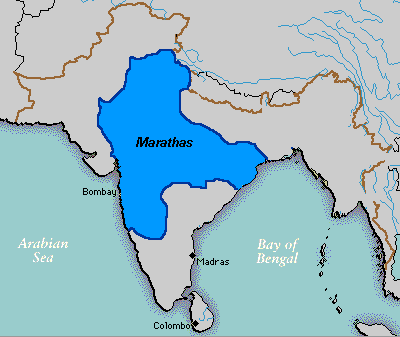
    One of the primary events complicit in the decline of the Mughals was the first significant event in the history of the Maratha Confederacy. The death of the Maratha founder, Shivaji, in 1680 was the impetus for the beginning of the War of 27 Years. Shivaji had formed a kingdom that proclaimed itself independent from the Mughals and the Mughals sensed that Shivaji's kingdom was primed to be reacquired now that he had passed from the scene. In marched the Mughals in 1680 to pacify the Marathas. Instead, they would be defeated in the Battle of Attani and then, in 1705, at Malwa they would be so utterly defeated by the Marathas that they relinquished their status as the unquestioned rulers of the Indian subcontinent and started a two year retreat that they completed in 1707 which brought the war to a close. After this triumph, the Marathas continued to conquer territory in central and northwest India as this map shows. That is, until they ran into the Durrani Empire.

    The Durrani Empire - 1747 - 1823

    Ahmad Shah Durrani, the founder of the Durrani Empire, is considered the Father of Afghanistan. Correspondingly, the Durrani Empire is seen as the precursor to the modern Afghan state. Durrani himself was a Pashtun and the empire he founded was primarily based on the power of the Pashtuns and centered around Kandahar. As the Marathas expanded towards what is now Pakistan, Durrani declared a jihad against them. Collecting his warriors, he met the Marathas at the Third Battle of Panipat on January 14, 1761. Though outnumbered, Durrani's forces crushed the Marathas so thoroughly that they ceased to be an empire and devolved into a loose confederation of principalities. As this map shows, the Durrani Empire ruled all Afghanistan, all Pakistan and parts of northwest India and northeast Iran. Durrani's death in 1772 would mark the beginning of the decline of his empire, which was helped along in no small part by the colonial exploits of Britain and Russia.

    British Raj - 1858 - 1947

    The British Raj (raj is Hindustani for "reign") commenced in 1858 when the British East India Company transferred control of its holdings to the British crown. However, it had been working its way into India for around two centuries before it made the British monarch the leader of India. During the latter 19th century the British finally succeeded in wresting away from Afghanistan what is now Pakistan and solidified its control by having Afghan ruler Abdur Rahman agree to the border demarcated by the Durand Line. Rahman agreed to this to gain political peace after two wars with the British and the Russians approaching. The Durand Line would come to play an important role in the present. This map shows the post-Durand British India. After the exhaustion of two world wars, the British would confer independence on British India in 1947 by giving half to the Muslim inhabitants and half to the Hindus and Sikhs.

    The exit of the British spelled the end of a single power ruling the Afghanistan, Pakistan, India axis. It also spelled the beginning of modern Islamist extremism. It was Islamists infiltrating Kashmir in 1947 that occasioned that principality to be occupied by Indian troops. The sovereign did not want to accede to Pakistan or India but when he requested assistance from India they demanded he accede to them before they would assist him so he did. It was the flash point of another war in 1965. Then in 1971 when Pakistan was embroiled in a civil war, India gave military support to East Pakistan which successfully seceded and is now known as Bangladesh. Bangladesh is more or less a client state of India with 15% of its imports coming from India, their large trade deficit with India and 75% of regular trade occurring illegally with India. (Source) Thus, Pakistan feels constantly surrounded and threatened with Iran to its west, India to its east, Bangladesh as an ally of their mortal enemy and China their lone strategic ally to the northeast. It is this cooped up feeling that drives their foreign policy.

    Pakistan felt itself being hemmed in even further than it is now when the Soviets invaded Afghanistan in 1980. India had aligned itself with the Soviets during the 1971 war with Pakistan and now here were the Soviets attempting to take over Afghanistan and move in right next door. Pakistan's dictator Zia ul-Haq (who was responsible for executing Zulfikar Ali Bhutto, the father of the slain Benazir Bhutto) utilized the ISI (Pakistan's version of the American CIA) to funnel weapons and other necessary material to the mujahideen (holy warriors) fighting the Soviets across the border. Pakistan was forced to play host to over a million Afghan refugees. There were many young male refugees and Zia ul-Haq undertook to build Islamic schools where they could be molded into mujahideen and sent to fight the Soviets. Congressional representative Charlie Wilson soon became involved in the resistance movement and along with the CIA's point man on the Afghan war, Gust Avrakotos, secured U.S. government funding and, later, Saudi matching funds to provide the mujahideen with the implements of war with which to drive out the Soviets. Pakistan, the only pipeline to the mujahideen, refused to participate unless the resources were given to them to distribute. They accordingly armed the fighters that had the closest ties to them and distributed practically nothing to fighters they did not want playing a part in postwar Afghanistan, like Ahmed Shah Masood.

    Pakistan was also working on a nuclear weapon during this time in response to India's successful nuclear bomb test in 1974. It was the fabled and feared Islamic bomb. Pakistan had extracted an agreement from the Reagan administration to look the other way on its nuclear program in return for it operating the guerrilla war against the Soviets. Part of the cost of sending the Bear back over the mountains was two mortal enemies in a nuclear standoff as well as the nuclear weapons technology and equipment exported from Pakistan to other countries. Time will tell whether it was worth the price.

    The Soviets withdrew in 1988 across the Amu Darya back into their own territory. Afghanistan fell into a civil war that eventually boiled down to Pakistan's chosen rulers for the country, the Taliban, and the Northern Alliance led by Ahmed Shah Masood. The Taliban made good progress fighting the Northern Alliance. In an indication of who they believe their forerunner was, they held a ceremony at the tomb of Ahmad Shah Durrani in Kandahar in 1996 where they acclaimed Mullah Omar their ultimate leader and declared that they were now the rulers of the newly-created Islamic Emirate of Afghanistan. (p. 328 Ghost Wars Coll, Steve) In May of that same year, Osama bin Laden was exiled from Sudan and took refuge in Afghanistan, one of the few options open to him. The Taliban welcomed him with open arms because he brought money and Arab fighters to their jihad against the Northern Alliance. It is no mystery how the Taliban had managed to confine the Northern Alliance to a small area of the country. Pakistan was not only sending madrassa graduates to fight with the Taliban, but ISI officers in the flesh were fighting with them as well. Not to mention bin Laden's Arab zealots. However, the relationship between the Taliban and Pakistan was not one-sided.

    Fitting in with Pakistan's central thesis that it is surrounded, its foreign policy pursued two avenues. The first was the support of the Taliban and their enthusiastic assistance to assure that the Taliban would take control of neighboring Afghanistan. With the Taliban firmly ensconced as the rulers of Afghanistan, Pakistan would have leverage with other countries in negotiations because it could wield its influence over the Taliban if it so chose. The second avenue that Pakistan pursued was the tangible fruits of its labor for the Taliban. At some point after the 1971 war, the Pakistani army concluded that the Indian army outnumbered it so severely that it needed to pursue strategies that would tie down large numbers of Indian troops and even up the odds. Pakistan had been sending Islamists to Kashmir to cause trouble for a while before Osama bin Laden came onto the scene, likely diverted from the madrassa graduation classes. The madrassa students would matriculate to killing Northern Alliance soldiers or killing civilians and Indian soldiers in Kashmir. bin Laden now gave Pakistan another more effective, deadlier option. bin Laden took over training camps in Afghanistan to train his operatives that would go on to commit the embassy bombings in Kenya and Tanzania as well as his September 11th hijackers. However, he was also currying favor with Pakistan by supplying them his (comparatively) well-trained operatives to be sent to Kashmir on jihad and occupy Indian troops, requiring larger garrisons. Indian troops that could no longer be stationed on India's border with Pakistan.

    The trouble for Pakistan began with a day that changed international circumstances. September 11th resulted in the invasion of Afghanistan and a war that killed some of their allies and drove the rest into the northwestern frontier where the writ of the Pakistani government simply does not go. When bin Laden had spent some time with the Taliban, they had concluded that one of their goals was to revive Islamic governments in Central Asia where they had been smothered by the Soviet and Red Chinese governments and now are being smothered by the successor governments to the Soviets. The Taliban and bin Laden idolize Durrani and Durrani's Islamic emirate controlled not only all of Afghanistan but it controlled all of Pakistan as well. The Islamic Mughals controlled all of the Indian subcontinent. Once upon a time Pakistan exported its extremists to vent their rage on the Northern Alliance or Kashmir. Current conditions have bottled those extremists up in the most restive part of Pakistan most of the time (when they are not conducting raids in Afghanistan, they are in Pakistan hiding from the Americans) where they can make other Pakistanis that are on the fence into angry extremists that want an Islamic emirate in Pakistan. They have figured out that Afghanistan is a secondary objective and that Pakistan is the true prize. Pakistan has both nuclear weapons and reactor facilities that have material for a dirty bomb. Pakistan's ISI and the army (to a lesser extent) is riddled with Taliban sympathizers and these are the institutions that participate in protecting Pakistan's nuclear weapons. It is possible that the Taliban could engineer a coup in which they acquire Pakistani officials who can both launch and, if desired, reprogram the nuclear weapons. Even if they do not recruit Pakistani officials that can do this, there are enough Western-educated Islamists that the Taliban could recruit someone to do so.

    Not only are the Taliban and their allies the problem of the current regime in Pakistan (which, in reality, is and has always been the Pakistani army) but, because of Pakistan's nuclear weapons, they are the problem of Pakistan's neighbors and America's problem. A nuclear weapon is the perfect method for a suicide bombing. It is, in fact, the ultimate suicide bomb. You can fire all that you have and kill thousands or millions of infidels and then wait to be vaporized by the retaliatory strikes. This is the Pakistan Problem... welcome to finding a solution before the unthinkable happens.

  • State lawmakers gave initial approval Tuesday to a bill that could allow offshore drillers a chance to set up rigs within sight of Florida's Gulf of Mexico beaches. A surprise introduction of legislation by Dean Cannon, R- Winter Park, slated to be House leader next year, calls for lifting the state's decades-old ban on rigs and giving the governor and Cabinet authority over proposals for drilling between 3 to 10 miles from shore.

  • President Barack Obama wants to cut federal spending and he is asking for the suggestions of citizens for how the federal government can cut the record federal spending. What would you tell the President to cut?

  • Socialism is probably one of the single most misunderstood political ideologies in the United States. Though the US had a sizable number of socialists at the turn of the century, the Cold War, McCarthyism, and the Red Scare have thrown it unceremoniously into the category of "extreme." Even today, right wingers are quick to scare people from supporting welfare reforms and higher taxes as being socialist; this is a blatant lie, one that I intend to lay to rest right now.

    Socialism tells us one very important thing: workers should control what they produce. From this comes a plethora of ideas and inaccurate characterizations but it are, in truth, really quite sensible. Taking any average company, normally you have someone who is in charge, and then a hierarchy leading down to the lowest possessions which usually do all the work. Organization is a key part of society, but this hierarchy is an economic copy of the kind of despotic governments that democratic societies discarded long ago. It means a handful of people, with few checks and balances, decide, not only how much the producers make, but also how much they themselves make, an obvious problem when it comes to greed. This problem manifested itself quite fully during the Great Depression. Essentially it puts an unnecessary middle man between producing and purchasing. It means that a handful of people control what is produced, and can charge what they want to increase their own paychecks and possibly reduce the paychecks of workers, again, with no checks and balances. Socialism is an idea that seeks to eliminate the greedy middle man. Workers should control what they produce.

    Socialism is not a form of government; it is an economic system. Socialist ideals are better at telling us what kind of government NOT to have then what government we should have. On the list of governments that simply cannot fulfill the ideals of socialism are monarchies, oligarchies, aristocracies, and dictatorships. These governments put one person in control, effectively making it impossible for the average person to share control in production, since the average person ultimately answers to one (or a few). Socialism then almost has to be very democratic in order to ensure the worker his equal say in production.

    In essence, socialism is democratic economics. A simple transfer of the governmental organization we currently use, into the economic system. Putting workers in charge of economics prevents the same evils of greed, selfishness, and despotism that democracy does in government. The demonizing of socialist ideals has put this basic concept of democracy as the best form of societal control far from many American's minds.

    It is also important to realize that socialism on a large scale has only ever been implemented in partial form. From the right we hear frequent examples of "socialist" governments like China, Venezuela, Cuba, and the former U.S.S.R.. Though these governments may have claimed socialist ideals, they have all been far from them; the socialist slogans used by these countries is about as meaningful as the names "The People's Republic of China" and "The Democratic Republic of the Congo" are to democracy. Again, the basic precept is that workers must control capital. Their economic systems are different then the one used in the US; the GOVERNMENT controls capital in these countries, but it is not socialist because the PEOPLE do not control those governments. In order for true socialism, the countries must be democratic in nature. Otherwise, the corporate middle man, or the corporate middle man who controls the government, is still taking advantage of workers' production.

    In short, socialism represents all the democratic ideals that we Americans value: hard work with reward, equality, and more importantly prosperity that can never be hindered by a mere handful of people. A socialist then is simply someone who doesn't want his life controlled by a CEO in the same way that most supporters of democracy don't want their lives controlled by a dictator or king.

  • Far from ending rural poverty, the real consequences for China's 800 million peasants will be a rapid increase in landlessness and a dramatic widening of the gap between rich and poor. The aim of the new policy is to force peasants to give up their plots to agricultural enterprises and create more cheap labour. The turn to large-scale agricultural production to maintain food supplies to the rapidly swelling urban population will accelerate the decay of small-scale farming.

  • WASHINGTON--High-ranking officials from the People's Republic of China descended on Washington today and offered to buy a controlling share of the United States Treasury, Steve House News Wire can now confirm.

    The development comes on the heels of a drop in the Dow Jones Industrial Average totaling nearly 1,000 points since Friday. According to US Treasury officials, the purchase did not go through due to a Chinese misunderstanding of free-market capitalism and business hours.

    "Dude comes up to me and he's like, 'I'd like to purchase a controlling share of your government on behalf of the Government of the Glorious People's Republic of China,'" said Jack Sanders, who was at a local bar at the time. "So I told him to buzz off, I can buy my own drinks."

    SHNW Chinese correspondent Rachael Xi reports:

    The Chinese government seems to think that they can simply buy the government since the economy is in shambles. They've already given America billions in loans, so this seemed a logical next step. They also missed the part about closing in the late afternoon somehow.

    The miscommunication has been redressed and the PRC has since rescinded the offer. I'm Rachael Xi, Steve House News Wire.

    Rumours that the Chinese are interested in buying the faltering AIG from the Fed are as-yet unconfirmed, and further rumours that they have purchased the entire New York Stock Exchange have been proven bunk.

  • In response to the hoopla and protests regarding China's human rights record in the run-up to the Olympics, the Chinese protested by publicly burning a Tibetan Buddhist monk yesterday, SteveHouse News Wire has learned.

    The Chinese government has been under massive international scrutiny in recent months, and "Free Tibet!" has become the new "Save Darfur!" outside campus Starbucks stores. China has been determined to make sure the Summer Olympic Games go as smoothly as possible, including stifling dissent and building brick walls in front of dilapidated buildings1. Worldwide, the nation's mistreatment of the Tibetan people has sparked protests and a new way to be cool.

    "We are sick and tired of all the anti-China protests," said a government official through a translator. "We decided to hold our own anti-protest protest."

    "Yes, it was because of all the protests, mostly because we believe they are wrong, but also because we felt really left out," she added later. "We want to change the trend to 'Release China!' by autumn and be cool too."

    SHNW interviewed two local college students. One said he found it to be quite disturbing. When riot police immediately tossed him in a black van, the other said, "@!$%# that dude, I'm a patriot! Release China!" He then walked away briskly, looking over his shoulder every five steps or so.

    A spokesman for President Bush declined to comment, but the President himself had this to say: "What got set on fire? I love a barbecue!" (His handlers made hushing motions and we were sent on our way.) Presidential candidates Barack Obama and John McCain declined to comment as well.

    1They actually did that. It's not me being crazy.

  • Tibetan protests have sprung up globally, and with the exception of the protests in Tibet itself, they have remained by and large peaceful in other parts of the world. All of us know the reason for these protests, but what surprised me was the reaction of governments all over the world towards these protests.

    Ironically, while most of the governments praise themselves over the high ideals of democracy, liberty and freedom, they couldn't even show compassion towards the peaceful protests by the people of Tibet. China's human rights record is not clean in China itself, what would be the condition in Tibet, is anyones guess. Information is difficult to come by, and going by the large number of Tibetan refugees in different countries, it doesn't take a rocket scientist to make an intelligent guess over the conditions there. I speak of the number of these refugees as a proof, because people migrate from their country so unwillingly and in such large numbers only when there is a problem. But I am digressing here, let me come back to the topic.

    Governments the world over have been more or less silent on China's brutal crackdown on the Tibetans. Though many have come forward to speak against Chinese actions, the words have been largely cosmetic.

    The links I am about to put forward next, will mostly be seeds from the newsvine community. The seeds I came across while going through the vine.

    India and Nepal have the highest concentration of Tibetan refugees. And both the countries have been quick to suppress any anti-China rhetoric within their boundaries. India, which hosts the Tibetan government in exile, was quick in clamping down on silent protesters who were on a march to the Tibetan border. All people in the protest were arrested and sent to custody for 14 days. India seems to have heeded to advice from "friend" China.

    Nepal seems to have gone one step further. Nepal police used brute force on Tibetans, leaving many injured. This link seeded by sirensongs show how Chinese officials actually handled the riots in Nepal, and perhaps even ordered the brutal suppression that took place. The same link also says this about presence of Chinese officials in during a protest in Greece.

    The Chinese embassy officials filmed Tibet protestors who symbolically lit a torch as part of a Tibetan Freedom Torch Relay in the buildup to the summer Olympics in Beijing. Tendon Dahortsang, of the Tibetan Youth Association in Europe, told The Guardian, "Greek authorities told us we were not allowed to go in because of our big bags, as Chinese embassy officials stood nearby and watched us." When a BBC reporter challenged the Chinese officials for their involvement in impeding a peaceful protest in a free country, the Chinese officials became angry and shouted at the camera that Tibet is part of China, before telling the reporter that he was 'stupid' and walking away.

    The Swiss police decided to use teargas on pro Tibet demonstrators. The IOC, on the other hand, seems to be very sympathetic towards the Chinese. IOC President Jacques Rogge said the Beijing Olympics should not be boycotted because it would 'only' hurt the athletes.

    Right Mr. Rogge, we obviously don't want to hurt the athletes. But why does it appear no one gives a @!$# about Tibetan people.

    I would also recommend this wonderful article by Marilyn L on Tibetan protests.

  • (This is a small subsection of the final paper I wrote after visiting China. It describes, using academic resources and my own observations, the political and social changes happening in China. I hope you enjoy it.)

    Political Changes

    China's history of a strong government is being questioned in the "new China." As China modernizes, increasingly the state's power is being reduced. Economically, the state has relinquished power in controlling the economy. The market, in most sectors of the economy, now sets prices; even more integrally, and less obvious, is the step Deng Xiaoping took in allowing private business to operate, which shifts economic control from the public to private spheres.

    Another factor, although much more subtle, that is shifting power to the private sphere is the growing indifference to the Chinese government. While in Beijing and Shanghai, it became exceedingly clear that the people of these cities were simply not concerned with the government. Rather, they are concerned with going to university, going to work; they are concerned with succeeding for themselves and for their families. This shift of focus from the public to the private undermines the government's power because people just are not interested in it. Despite the existing regulation and censorship, and new laws that further it, the urban Chinese seem to almost ignore it and go about their lives, as if the Red Guard posted outside the Soviet Union-style government buildings are merely facades of the past.

    Just as many people seem to be focusing on their own lives rather than the government, there is a growing human rights activism movement in China, which is pushing for fairer trials and more free speech. Unfortunately, though, ahead of the 2008 Olympics in Beijing, the Chinese government is cracking down on these activists, hoping to eliminate "troublemakers." This movement, though, seems to be gaining momentum. People across the country, fed up with the government's harsh treatment of critics and the almost summary trial where suspects are often not given a defense attorney until a confession is elicited from torture, suggesting that, as time passes, the government will not be able to use such oppressive means. While China's conception of a free and fair state is quite different from a Western conception, many things are in common. The Chinese human rights movement desires a government that respects its people and treats them with the dignity they deserve, rather than as political enemies. Considering the rapid changes in other areas of China's political and economic spheres, it seems likely this movement will succeed.

    Paradoxically, though, as China's domestic power decreases, their international power is growing. One clear example of China's new economic clout is that China now holds over a trillion dollars of U.S. debt, the second greatest U.S. debt-holding nation in the world, second only to Japan. This gives China immense political and economic influence over the U.S., and by extension, the world economy. If China were to liquidate its U.S. debt, the U.S. and world economy would be thrown into chaos. Coincidentally, this is also what restrains China from doing so, because it would harm China just as much or more than the U.S., but the threat China has in releasing their debt-holding is sufficient to give them power.

    Moreover, China is closer to several nations, such as Burma (or Myanmar), Tibet, and the Sudan, than any other nation (besides India in Burma's case, but China certainly holds more influence). Their central asian and increasingly Middle East and African influence is quickly approaching the U.S.'s and, in some countries, has surpassed the U.S.'s.

    Social Changes

    Interestingly, tour guides speak of the "new China." While China's living standard is growing with their inevitable march toward modernity, old, traditional roles are being strained or broken completely. A modern nation depends upon women to take careers and push the country forward. Similar to the conflict in the U.S. that has developed in the last fifty years over women taking careers, China is dealing with the same issue. As women enter the workforce, their traditional role of taking care of their family is being re-considered. For some women, this is causing sadness, because they feel they are not fulfilling their roles; others are going the opposite direction and embracing being single and the freedom it brings.

    The influx of Western culture into China, too, is giving many pause. In Beijing and Shanghai, new buildings have undeniably Western architecture. Shanghai's skyline is, without question, Western. Beijing's Olympic construction has primarily been designed by foreign architects; for example, the famous bird's nest stadium was designed by a French architect. Food, too, is changing. KFC entered China in the late 1980s, and has had incredible success since. McDonalds entered in 1992 and although their success has not been as extreme, has done quite well (Aiyar). KFC, McDonalds and even Pizza Hut have become status symbols for the rising middle class in China. Because being able to afford eating at these fast food restaurants means that they have money they can spend on luxury goods rather than necessities, eating there symbolizes their success. Moreover, they are also a "Western" experience. In The Lexus and the Olive Tree, Thomas Friedman argues,

    "The Malaysians go to Kentucky Fried and the Qataris go to Taco Bell for the same reason Americans go to Universal Studios -- to see the source of their fantasies. Today, for better or for worse, globalization is a means for spreading the fantasy of America around the world. In today's global village people know there is another way to live, they know about the American lifestyle, and many of them want as big a slice of it as they can get -- with all the toppings. Some go to Disney World to get it, and some go to Kentucky Fried in northern Malaysia. Ivy Josiah, a young Malaysian human rights activist, once expressed to me the mixed feelings her generation has about this phenomenon. "I get emotional when I think of how our traditional restaurant stalls are going to be eaten up by Kentucky Chicken, McDonald's and Chili's," she said. "We are losing our own identity. We grew up with those stalls. But younger people did not…. For a Malaysian kid today the big treat is going to Pizza Hut. Globalization is Americanization. Elites here say, 'You should not have McDonald's,' but for the little people, who don't get to travel to America, they have America come to them." (294)

    I do not think quite the same thing in China is happening. While the competition between foreign fast food restaurants is certainly harming local restaurants, and the experience McDonalds and KFC offer is a feeling of modernity (their restaurants in China are much nicer than the ones in the U.S., coincidentally), I think the strongest underlying factor is a feeling of "we have made it." When Chinese eat at these places, it is an assertion of Chinese success, that they are a part of the modern world, too.

    The negative effects, though, are still there. Local restaurants are being run out of business, and tastes could shift away from traditional fare and toward the cheap but sometimes fulfilling taste of fast food. The harms, though, do not only extend to the Chinese. Unfortunately, for many people, their experiences in fast food restaurants can be a defining moment for their perception of Western culture. Fast food, which is probably the strongest example of the harms of commodification, is as representative of the depth of Western culture as China Wok Express is representative of Chinese culture -- sure, they kind of serve Chinese food, but it is a cheap knock off of the real thing, designed to be low cost and easy to make with little care for staying true to its origins. Globalization, it seems, both in its benefits and consequences, works both ways.

  • "Bustling" would be a gross disservice to just how quickly Shanghai moves. Businessmen, barhoppers, street salesmen, tourists, children, parents, students. They move fast, in a city that is only accelerating.

    During one day, our tour guide tells us, twenty new large buildings opened. This doesn't surprise me; as we drive through Shanghai, I see one skyscraper almost complete, cranes on top so high off the ground they look like miniatures, and several large construction sites preparing for more.

    After dinner at a fine restaurant our first night in Shanghai, I ride the elevator downstairs. A family rides with me, their young boy standing beside me. He stares up at me, as if he has never seen a white person before. Perhaps he hasn't, but I am surprised, since this is Shanghai, an international city.

    The elevator stops, and I walk to our bus. As I stare out the window, the boy and his mother walk out, and once again, he stands there, staring. I smile and wave, and he slowly picks up his hand and waves, too. The bus leaves as the boy and his family walk away.

    I can only wonder what he thought.

    Mix and Counter

    After visiting the bund, on one side the future of Shanghai and on the other the shameful signs of the West's imperialism, we retired to the hotel. As we stand in the lobby, a European walks by and strikes up a conversation with our group. "Are you students? It is so wonderful that you have the chance to visit China," he says in an accent. "And I love how mixed you all are! That is the great thing about America, everyone is so different! Holland is that way, too." His group begins to walk away. "Bye!"

    But before the night is over, I decide to visit the fashion shops across the street. They are all small, some no wider than my dorm room, and vary from affordable styles (one, as the picture to the right shows, was called "Sale") to high-end and incredibly expensive. All are run by young to middle-aged women, not a man to be found. Things are changing.

    But what I found interesting were what I can only describe as Chinese counterculture shops. We descend a small flight of stairs off the sidewalk, and descend into one, almost like entering an edgy club. A twenty-something year old woman sits behind the counter, her long, jet-black hair falling straight, her face pale white, and her lips in dark lipstick. She glares at us.

    The shirts reflect a discontent with the new China. On all black, a pixelated Mao adorns one. The shirt subtly screams that Mao is not left behind in the twentieth century, but an icon for the digital, globalized age, a symbol of Chinese independence. Another, black, has hands thrust into the air, but no fists; rather, floppy disks. The people's revolution continues.

    We exit, and her face, unchanging, seems relieved that we are gone. Tourists don't belong in this store, apparently.

    The Pearl

    The next morning, we visited the Oriental Pearl, China's largest TV and radio tower, and the third tallest in the world. The tower has angled columns rising to the first "pearl," which then jettisons up to the second pearl, the viewing deck. As I stand underneath it, the tower thrusts up into the sky, and it seems like I am standing before the future.

    After standing in a long line and going through a tamed version of airport security, we rode 263 meters into the air, to the sightseeing level. Glass panels down to the floor, you are offered an unparalleled view of Shanghai. Unfortunately, like most days, the day is overcast and somewhat brown-tinged.

    Inside, though, is clear. School children, all in matching green uniforms, excitedly run around. A boy and girl come up to some of us, notepad in hand, and quickly ask, "What do you think of the Oriental Pearl?" I reply, "It is like nothing I have ever seen," and they scribble something down. "Thank you!" And with that, they run off.

    These schoolchildren, we found out, are here to practice their English. Several more run up, and ask similar questions. "What do you think of Shanghai? What is your favorite part of Shanghai?" We answer, and ask them their names. Some answer, some are too shy or too unsure of their English to reply. "John," the little boy says. "Julia," a girl responds. I am somewhat put off by this; I wanted to know their real names, but nonetheless, we continue talking. One woman teaches them how to say "awesome," and in unison, the children almost yell, "AWWEE-SSOOMMEE" and break into uninhibited laughter. We pose with them, their teacher (or a parent chaperone?), smiling joyfully, takes a picture. It is a touching moment.

    Perhaps all they learned from us was some strange word, but I think it is greater than that. It showed me that, perhaps, our future as a world can be a bright one. Those children, in twenty short years, will be China's next leaders in various fields. It reminds me that the tensions we hold between ourselves as adults, are entirely artificial. Children do not understand those conflicts. For them, we are all just people, different, but people. We look different than each other, talk differently, and act differently, and those differences should be respected. But we should not let our differences act as roadblocks in the way from good relations. The world is growing too close for that.

    It also shows just how far behind education in the U.S. is, and motivation, are falling. In China, they are learning English from when they are kids. One thing I felt the entire time was incredible respect, and incredible guilt, because the people I met made such an effort to speak my language, in their country. We are too involved in meaningless affairs as students in the U.S., such as Facebook, videogames, and other time consuming, but ultimately useless, endeavors. When these children in China become their leaders, I fear we will be too far behind to compete. But they did show me: they will have earned it.

    Past Articles in this Series:

    1. "Reporting from China: Beijing, Both History and Future at Once"
    2. Reporting from China: The Forbidden City and the Summer Palace

  • The Chinese government's censorship of some Web sites with no discernible political content has fostered a backlash among Internet users.

  • On Thursday, January 16th, we visited the Summer Palace and the Forbidden City. It is an almost surreal experience driving to these sites. The Forbidden City, which received its name because people could not enter or exit without the Emperor's permission, lies in the center of Beijing.

    To get to the Forbidden City, you must drive through contemporary Beijing, a bustling city filled with advertisements, many cars, even more bicycles, Chinese and Western stores and restaurants, and the many other signs of a modern city. As your thoughts center on China's storied past, visual stimuli tries to pull you back into the present and future.

    Foreboding City

    Arriving at Tiananmen Square does not change this. Gazing upon the Forbidden City in the distance, its incredible architecture and size contrasting so strongly with the city, you remember that you are walking through Tiananmen Square, the largest square in the world, and the same ground where Chinese students decided to protest the dictatorial PRC, and where many lay dead. It is quite overwhelming to stand in a place where so much history, both current and past, has taken place.

    Tiananmen Square itself has an uneasy feeling. Its design, and the Red Guard that keep attention in front of the Forbidden City for tourists to take pictures, leave you with the unmistakable feeling that you are in Soviet Russia. But the many tourists walking around, both foreign and Chinese, tell a different story; they tell the story of a new China, broken from the past (even the recent past), where both the Forbidden City and the events of Tiananmen Square are such distant relics that they must be stared on with awe as an outsider looking in. In a sense, here, all tourists are one: all are foreigners.

    Tiananmen Square is indeed large, and certainly feels like it can hold a few million people. The Forbidden City, though, looms in the distance, and after spending twenty or so minutes in Tiananmen Square, we walked under the street between Tiananmen Square and the Forbidden City, and crossed its bridges. After entering, we walked through a long courtyard-like area, and then into the Forbidden City.

    Its walls are incredibly tall and foreboding; if there was ever an imperial palace, this is it. When this city served as the Emperor's city during the Ming dynasty (1368-1644 C.E.) onward, the sense of wealth and power it had must have been awe-inducing. As we walked into the inner portion of it, I was struck by its incredible size. Although its height is clear from Tiananmen Square, I did not realize just how utterly large it is, and how many buildings the Forbidden City encompasses. I have seen the White House and the U.S. Capital, and although both are beautiful buildings with great detail, they do not begin to compare to the architecture here.

    Many buildings do not use a single nail; instead, each piece of wood is finely crafted to interlock onto the other, creating a strong construction. The colors, too, are surprising. Each building has hand carved designs in it, with deep reds, yellows, greens and blues adorning it.

    Its alleyways are curved in shape, rather than straight. According to our tour guide, this was not to confuse tourists (although it serves that purpose, too!), but rather to confuse demons. Chinese tradition holds that spirits can only move in straight lines, so the alleyways are curved to give an advantage to the mortal if they are being pursued by spirits. Moreover, the pointed ends on top of the buildings, characteristic of older Chinese architecture, was done so demons cannot sit on top of the roofs.

    Inner Contemplation

    Whereas the Forbidden City was built as the Imperial City, the seat of all power in China, the Summer Palace was built, as its name implies, as a vacationing area for the Emperor during the summer. Construction first began on the Summer Palace in 1750, which included building a man-made lake and a man-made hill to mirror the West Lake in Hangzhou, regarded as the most beautiful lake in all of China. Kumming Lake is very large, and so is Longevity Hill. The hill, which was built using the excavated earth from the lake, exists to satisfy Feng Shui, which mandates that for maximum harmony, a lake must be backed by a hill.

    Here, we came across street vendors for the first time of the trip. When we exited our bus, they almost assaulted us, trying to sell beanies, hats, gloves, fake watches, postcards and even imitation Red Guard hats. These are some of the most persistent sellers I have ever seen; they literally will not take no for an answer, nor will they let the language barrier stop them. They know just enough English to describe their product, say why you need it, and how much it is.

    The Summer Palace is indeed nice, even during the dead of winter. Appropriately, when we visited it was snowing quite vigorously, and the beautiful lake was frozen over. The Summer Palace is almost entirely a large garden, with the lake as its focal point. The palace has a long, open sided corridor, beautifully designed, so the Emperor could, apparently, walk along the lake and enjoy its beauty without being in the sun.

    On the lake's right side lies Longevity Hill, and a beautiful pagoda. This is the first pagoda I have ever seen in person, but unfortunately, it was obscured (as you can see from the picture) by the day's weather. I hope to return to visit the Summer Palace during the spring some time, and see it in its full beauty.

    The Summer Palace reminds us of China's not so distant past, where, like the vast, open landscape of Kumming Lake, China focused on deep, inner contemplation, and natural beauty. Even its man-made structures, such as the lake and the hill, were built to mimic as best as possible nature itself. Perhaps we can all learn something from that: although there is much value in the present and future, in the technologies and artifices that we create, there is also much unearthed value in our past, and in nature. Mao's Cultural Revolution attempted to severe all connections to the past and only look to the present and future, and while that episode was particularly bloody and evident, we enter such a state slowly and much more dangerously by only looking to the future for answers to our current wishes and problems. Sometimes, we already have the answers and solutions to what we need. We just haven't realized it. Hopefully China does not forget its own lessons in the haste of its incredible ascendancy.

    Past Articles in this Series:

    1. "Reporting from China: Beijing, Both History and Future at Once"

  • After a fourteen hour flight from LAX to Shanghai, and a two hour domestic flight, we landed in Beijing in the early morning of Thursday, January 16th. After crashing into bed for the night, we got up early and headed out, met by a flurry of snow, cars, bikes, and pedestrians, some people going to work, many others going to university. Besides the staggering number of bikes, this scene looked little different than any other major city. China, there is no doubt, is a modern nation.

    Beijing, the capital of the People's Republic of China, is shaded by many different restaurant and store signs, and large advertisements, almost like a scaled down Time's Square. Audis, Volkswagens, the occasional Mercedes, and Buicks, some old, some new, speed across their wide streets, in and out of traffic, narrowly missing pedestrians. In China, cars have the right a way, and they use it; when making right turns, many people simply honk their horn as if to warn pedestrians they're coming, and to inform them that if they do get hit, well, it is their own fault. New York drivers have nothing on drivers all across China.

    Beijing is an odd mix of the old and the new. On one side of the street, you will see advertisements for clothing, electronics or anything else, along with new construction; on the other side of the street, you will see drab, Russian-style buildings, government buildings, with a Red Guard at attention in the entryway. It is a striking contrast; at once, you see the present and future of China, capitalist, quickly moving, modern, and you also see old China, the fabled Red Guard, symbols of Mao's destructive reign.

    Beijing is a very surreal place. While seeing so many advertisements, cars and well-dressed people gives Beijing a similar feel to a large Western city, where you are free to do as you please, this sense of freedom is tempered by the starkly different architecture of the government buildings with the Red Guard, which serve to remind you who is really in control.

    The people of Beijing do not seem discontented with their one-party government. They are concerned with going to school, or going to work -- with succeeding. They almost ignore it, as if government censorship and limited freedom are merely minor annoyances in their unalterable path toward success. The Chinese people are on a mission, both personal and national.

    The tour guides refer to China now as the "new China," one where capitalism is the dominant economic system, and prosperity abounds. They are very proud of their country, both their long history, and their recent ascendancy from Mao's destruction to their current blistering economic growth rate. This enthusiasm is clear in all parts of the city and, indeed, all along Eastern China. The same look of eagerness for the future, for work and success, is on the faces of street peddlers and shop owners, and important business people.

    But while this is a new period of economic reform, a free market is certainly not new for the Chinese. China has a long history of, if not free markets, regional specialization and trade. Historically, the Chinese have been quite entrepreneurial, and adept at marketing. This is no more evident than in the old shopping streets of Beijing. These buildings are very old, the streets already narrow filled with thousands of people, but the stores range from upscale clothing stores to old-style tea shops. The smaller shops are trying anything they can to bring people in; many shop owners stand outside with a loudspeaker and beacon people into their shop. Old meets new in these streets, which is a metaphor for Beijing itself; at once China's capital city, home to both the Forbidden City and Summer Palace, and only an hour and a half from the Great Wall, and also one of the main center's of China's economic miracle. There is innovation in the air on these streets, even as history swirls with future.

  • This is going to be quick, because it is 1:30 AM local time and I need to be up in five hours. I have been in China for five days now, and it is incredible. Beijing is by any definition a modern city, and a quite nice one at that; its streets are wide, and buildings new. New buildings are going up very quickly as they prepare for the Olympics. It is quite clear that Beijing is proud of hosting the Olympics because signs, advertisements and Olympic memorabilia is every where.

    The most interesting part, though, has been farther south in Suzhou, Wuxi, and Hangzhou. These three cities are, although not as well known as Shanghai and Beijing, rapidly developing. The growing standards of living is evident everywhere I go. I have been pleasantly surprised by just how many cars there are in the streets across the country, and nice ones at that.

    The Chinese have openly embraced capitalism as a means to success. This is clear on the streets of Beijing in the little shops, and along the Great Wall, as enthusiastic vendors forcefully peddle their product. They are eager to succeed, to "become rich." The Chinese are very hospitable and accepting people; although it must be aggravating dealing with foreigners who know little of their language, they deal with us with patience and brotherhood, trying their best to speak English.

    I'll have more to write when I get home Wednesday. Interestingly, in Beijing Newsvine is banned completely, but I am able to access it here in Hangzhou.

    Until later,

    Kyle

  • Since the Qin unified China under one empire in 221 B.C.E., China has dominated East Asia. Despite various dynasties throughout its history, China has earned the respect (and fear) of its neighbors, requiring that they pay tribute to them. Even so, however, by the 19th century China became a lesser power, forced to submit to the colonial desires of ascendant European states. This incredible reversal first began with their rise to power as a result of a large empire and, in the latter period, a budding market economy, and ended with their colonization due in part to the very traditions that had given them strength.

    Rise

    Large empires tend to deteriorate over time as a result of the diverse peoples and cultures that make up their empire, which leads to a fractured society and thus a weak state. China, though, remained unified throughout its long history despite its incredible size. This is due to a common culture that all Chinese share, based upon the classical texts of the Warring states period. With rare exception, this unification allowed China to enjoy the benefits that a large empire affords with few of the repercussions.

    Smaller states, by their very nature, have a small and simple economic system. Under an agricultural system, then, these states are at the mercy of nature itself. If their primary crops do not succeed, the nation will starve. China's large geographic area, though, encompasses a variety of different climates and conditions. Thus, if one region encounters unseasonable conditions and their crops fail, other regions will still have successful harvests and will be able to feed the people of the first region. This large economic system allowed China to weather bad conditions better than most other states, thus preserving and strengthening their power.

    More simply, their larger empire allowed for a strong state through sheer numbers. More people means more taxes, a larger army, and more workers. All three combine for a stronger state and a stronger country, and China took advantage of them. China could simply out-power the rest of East Asia because of their size. None of this, though, would bolster their power without their unifying culture; a large population is only a benefit when those people are unified into one people, which is not the tendency of large populations. Similarly, the environmental diversity of China would not benefit the country if the peoples of different regions were not willing to help each other. A large nation is dependent upon a strong, central culture.

    Although capitalism is typically cited as first beginning in the cottage industries of Europe, China in many ways pioneered the market economy. During the Song Dynasty (960-1279 C.E.), China developed a vibrant and diverse economy outside the bounds of the state. In A Brief History of Chinese and Japanese Civilizations, the authors write that "Commerce was facilitated by the use of paper money, a Chinese innovation that originated in Sichuan…" (224) More interestingly, Hangzhou, a Southern city, was known for its commerce. Hangzhou was a city of "bridges and canals. All kinds of merchandise, ranging from staples to luxury goods, were sold in the city. Olive, crab, ginger, water-chestnut, and orange dealers had their own guilds, as did cap makers, goldsmiths, and twine makers," among others.(224) This private, commercial trade between different regions of China helped interconnect the nation and reap social and economic rewards. This growing commercial class also led to the development of the Chinese Navy in the Song and Ming dynasties, which was the class of the seas, to trade with the rest of the world. China's world trade further strengthened the nation by bringing corn and sweet potatoes to China, which grew in soil that rice and other native crops would not. These new crops made farmers more efficient, both increasing their own wealth and providing more food for the nation, allowing a population boom that by 1800 would stand at over 300 million people.

    Fall

    Ironically, it was the very traditions that held China together that opened it to its fall from power. China's market economy and open trade led to tremendous economic success, Under the Ming Dynasty (1368-1644), China's Navy stood at its strongest point ever. It had the largest armada of ships in the history of mankind until World War 2. Fearing the growing commercial class would weaken the state and destroy social stability, though, Chinese government officials saw their extension -- the Navy -- as a threat to the nation. Thus, in the early fifteenth century, the Chinese Navy was destroyed, and their blueprints destroyed, so their ships could never be built again. It worked; China never regained its maritime strength. This decision to re-focus the country in on itself rather than the rest of the world cost the Chinese dearly. After the Ming Dynasty had collapsed and the Qing Dynasty (1650-1800) rose to power, European nations began colonizing the Chinese from the seas with impunity because China had no Navy to defend them. This turn inward received its final completion in the 20th century under Mao Zedong, who, through his "Cultural Revolution" and "Great Leap Forward," both of which sought to re-establish government domination socially and economically, and insulate China from the world.

    China's market economy, though, played a part in China's weakening. Although its move toward a market economy led to rapid economic growth, it moved too quickly. As a result of the rapid increase in agricultural efficiency, and the acquiring of corn and sweet potatoes from the Americas, China's population boomed, growing from 75 million people in 1400 to 420 million people in 1850. Before these crops were introduced, China was largely dependent on rice, which can only be grown in certain conditions and certain areas. Thus, China's population was kept in check by how much farmland they had; despite their cutting down entire forests to make way for farming, China's population would have hit an economic wall. The introduction of these two crops, though, made their farming more efficient, and thus could support a much larger population. This rapid population growth kept labor costs low, and reduced the need for technological innovation. This, combined with China's ending of most foreign trade during the Ming, combined to keep China beholden to an agricultural system until the late 20th century.

    China's history is incredible, and one fraught with irony. Due to the cultural unity the Qin and Han provided, the Chinese were able to unite under one empire that proved incredibly strong. These very strengths, though, ended up being the causes of their fall from power. Not recognizing just how much the development of a market economy and foreign trade had strengthened the nation, the Ming Dynasty destroyed their Navy, causing China to be defenseless to the coming colonization by the Europeans. Moreover, the population growth that strengthened them led to a long term malaise of economic development. China's history is teeming with lessons for our current day.

  • For the past two and a half months, I have been helping a professor of mine at Whittier College organize a live video teleconference between two panels of business experts on where the U.S.-Chinese business relationship is going to be in twenty years. I will be at the event, blogging about it as it happens on Newsvine.

    Linked by video streaming over the Internet, these two panels -- one of American business leaders in the U.S. at Whittier College and the other panel being Chinese business leaders at SIAS University in China -- these business leaders will answer questions on the political, economic and environmental aspects of the incredible growth of the Chinese economy, and what that means for relations between these two superpowers.

    The college I attend, Whittier College, has a unique position on this issue, as it is Richard Nixon's alma mater. Nixon did succeed at one thing in his presidency, and that was helping open China to the world, which has led to the amazing development China has seen in the past thirty years. As such, we have been conducting a Nixon series of events both discussing the past as well as the future. This conference is the latest in the series.

    This conference will be held on September 26th at 7:30 P.M. Pacific time. I want to blog it here on Newsvine for several reasons. First, this is an exciting event for me to be a part of, and I want you all to hear about how it goes. The second reason is that I think Newsvine should increasingly be a part of major events such as this, and for the community to play some part in it.

    At the end of the event, the panelists will participate in a Q&A; session. Are any of you interested in submitting questions for the panelists in relation to China? If so, let me know. I'd love to have you all participate in the event.

    Also, there is a possibility that we may be able to provide a live stream of the event to anyone that wants to watch it. I am not sure if this will happen, but would any of you be interested in that?

    Do you have any other ideas, or cool things that could be done?

    For more information, visit the nixoninchina"">event website.

  • There is nothing steamy, or gratuitous or catty about any of the posts on actress-turned-director Xu Jinglei's blog - the world's most widely read, with 100 million page views in less than two years.

  • Ah-ah, auto pilot no control
    Ah-ah, ahh
    Ah-ah, auto pilot no control
    Ah-ah, ahh

    - Queens of the Stone Age, Auto Pilot.

    What is your point of reference? What is most important to you? What is the thing in your life that you live for, every day of your life?

    Sadly, sometimes I cannot answer those questions. What am I living for? I get up every morning at 8:20 A.M., check the news, catch up on Newsvine, eat breakfast, and go to class. Why? Sometimes, I do not know. And I suspect many of you feel the same way.

    Why? It is good to sit back and ask that question, because throughout daily life, we do not have the time. Between providing for your family if you are married, or tending to class if you are a student, we are constantly moving from one thing to the next. Go to class, go to lunch, do work, go to work, go, go, go, and in-between, allow ourselves to escape by browsing the Internet or watching TV.

    I love computers, I love MP3 players, I love technology. But at some point, these devices, and the Internet that they connect to, becomes harmful. We live lives where we must move from obligation to obligation, quickly, always working. Even when we have time to relax, we tend to think about the obligations we have; the meeting at 4:00, the paper due Thursday, picking the kids up from school. And so, to escape these obligations, we use technology. It is a form of escapism. We sit in front of the TV, and pretend it entertains us, stimulates us. We sit in front of the computer, and pretend we are constantly learning something.

    We're not. We are giving our brains cheap stimulation, cheap mass stimulation, something that in a marketing-saturated, fast-moving, big media society, it is something that is necessary. We need it. We need the TV to speak to us and show us nice video and amusing but meaningless shows. We need the Internet to show us the wonders of the world that we aren't living. Our brains require constant stimulation. It has become a drug, a prozac that enters through the eyes and ears as it lulls us.

    Not only do we demand things quickly -- we want it now, now, now -- but we cannot be bothered to stop, have patience, and really analyze something. Even for those who ardently pay attention to the news, we move from one news article to the next, reading, reading, reading, but not thinking. But there is much value in one news article, one editorial, one piece of poetry. Through thought, analysis, meditation, it can reveal unknown things about the world. As we consider something deeply, we begin to see patterns within it, and within ourselves, patterns of the natural world. Laozi, a classical Chinese philosopher, once said,

      Those who know others are knowledgeable;
      Those who know themselves are enlightened.

    And herein lies the problem with technology and our fast moving, mass consumption, mass stimulation society. In the time we have to do deep reflection, to find our "heart's true desire," we spend it by attacking our minds into submission with media. No good thought can come out of this; no progress can result; only lukewarm stillness abounds, and out of this results decay in all senses.

    And so, I call on myself, and hope others follow suit. I call on myself to swear off technology for a small period of time, enough time to realize exactly what it is I want, what I live for. Enough time to meditate each day, to clear my mind of the debilitating amount of things running through it, and live. To turn off the auto pilot, and take back control.

    But not before the next episode of 24.

About this Group
Members: 1861
Established: 11/2006
Group Type: Public

Follow Writers to get e-mail or watchlist alerts whenever new content is published, or subscribe via RSS:

RSS
RSS feed Syndicate this contentPopular Articles & Seeds
There are no recently published popular articles & seeds at this time.
Writers's Private Content
Writers has not published any private articles, seeds, or discussions that you have access to.