Contact us

Omniture Articles
"And You Might Also Like...": Virtual Suggestive Selling On The Web
Unlike the catalog where space is a premium, the Internet's non-linear, electronic environment virtually enables unlimited up-selling and cross-selling to generate incremental sales. However, as in print, the key to successful use of this tool is making those referrals relevant. This article provides guidelines for effective implementation and highlights findings from recent research initiatives at the e-tailing group, inc. relative to cross-selling and up-selling online. From there, we provide best in class examples to illustrate the effectiveness of this selling tool.
With a focus on the art of merchandising online, the e-tailing group specializes in helping clients to improve their multi channel shopping experiences. To determine benchmarks for best-of-breed e-commerce, annually, in the critical 4 th Quarter, we Mystery Shop 100 sites selling a cross-section of B2C product categories and each year in the 1 st Quarter we extensively survey over 300 senior executives with responsibility for e-commerce.
When merchants were queried about which features they would most like to add to or improve on their sites, assuming resources were not an issue, in priority order, the three named most often were: personalization, improving search, and up-sells/cross-sells.
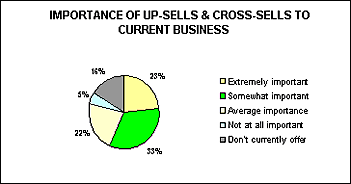
Asked about the importance of up-sells and cross-sells to their current business 57 percent responded that they are extremely or somewhat important and just 16 percent are not currently using this feature.
Location, Location, Location
The importance of this tool now clearly established, location on the site is the next issue at hand. Following the catalog metaphor, online, suggestive selling is traditionally found on the product page. Smart merchants are also using these tools in their shopping carts to encourage last minute impulse buying behavior with some also having success in post order communication.
To gain an understanding of the value of specific merchandising features, surveyed merchants ranked 39 features on a five-point scale: 5 being very valuable and 1 indicating not at all valuable. This year we added the emerging suggestive selling tool, Shop by Outfit/by Room to the list and were pleased that 28 percent ranked it of value—considering 67 percent do not have this feature on their sites as it is category-specific.
VALUE RANKING OF UP-SELLS AND CROSS-SELLS
| Very Valuable |
Valuable | Somewhat Valuable |
Not Very Valuable |
Not at all Valuable |
Not on Site | |
| Product Page | <20% | 35% | 23% | 6% | 1% | 15% |
| Shopping Cart | 13% | 25% | 20% | 5% | 2% | 35% |
| Shop by Outfit/ Room |
7% | 12% | 9% | 4% | 1% | 67% |
The Bottom-line
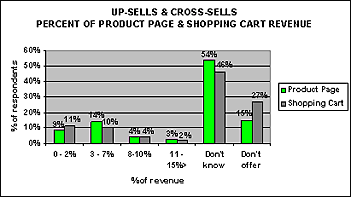
Further examination of the placement and performance of up-sells and cross-sells by those merchants we interviewed revealed that revenues of up to 7 percent are achieved via these features by 23 percent of respondents on their product pages and by 21 percent in their shopping carts. Respectively 15 percent and 27 percent do not currently offer these features as merchandising tools on either the product page or shopping cart.
Testing and Measuring are Essential
It was disappointing to learn that 54 percent & 46 percent respectively do not know what percent of revenue these features contribute as the Web enables direct marketers to test and measure in real time and with frequency not possible in print. We also recommend using your website as a testing ground for offers and packages that may be applicable to your print catalogs.
Consistency Counts in Cross-selling
Customers have come to expect consistency across channels. From branding to merchandising to customer service your site and catalog should offer similar experiences and integrated functionality wherever possible. Optimally all channels are using the same merchandising calendar and concurrently showcasing the same products—and their related items—whether in the store, the catalog or the Web.
Merchants Take the Lead on Upsell and Cross-sell Placements
Whereas the Web was once technology driven, the channel has evolved to the point that merchants and marketers need to be in control. 77 percent of the merchants we interviewed said that determining up-selling and cross-selling features and locations was the role of merchandising.
Frequency of Change Should be Assessed
Twenty-two percent of up-sell and 20 percent of cross-sell changes are made on a monthly basis. In an effort towards cross-channel consistency, 11 percent and 12% respectively are being timed with catalog drops.
FREQUENCY OF PAGE CHANGES
|
Daily |
Weekly |
Biweekly |
Monthly |
Quarterly |
With |
Cross-sells |
9% |
12% |
6% |
20% |
13% |
12% |
Up-sells |
9% |
11% |
8% |
22% |
10% |
11% |
Having merchandising specialists in charge should assure that that up-sells and cross-sells are relevant, which is essential to garner the desired sales boost. The e-tailing group's Mystery Shopping study provides some reliable relevancy benchmarks based on ranking of recommended products on a five-point scale with 5 indicating the most relevance. Product page relevancy improved from 3.13 to 3.24 over the last two studies; shopping cart relevancy improved even more, from 3.53 to 4.32. This research also suggests that an average of three products is typically populated in these locations.
The order confirmation email provides another prime opportunity for placement of up-sells and cross-sells as this is one email that recipients are almost certain to open. Our Mystery Shopping spree found 38 percent of sites currently deploying this tact, of which 47 percent presented up-sells and 29 percent cross-sells.
How Does Your Site Stack-Up Against These Metrics?
Even if you see room for improvement we intuitively understand, and all of our research concurs, that the most common issues for merchants deal with standardizing, integrating and executing the multi-channel shopping experience. Given existing constraints, from both a people and technology perspective, resources remain a challenge.
We see the need for more analytics tools to improve tracking and reporting plus scaleable, dynamic technologies to deliver relevant functionality for features like up-sells and cross-sells to a growing audience—but again advise judicious implementation. The following checklist is meant to help you make the most of this valued feature.
CHECKLIST FOR GROWING THE AVERAGE ORDER SIZE
WITH UP-SELLS AND CROSS-SELLS
- Consistently position up-sells and cross-sells on every product page
- Capture last minute impulse sales with these tools in the shopping cart
- Include these tools in emails, particularly the order confirmation email
- Recommend an average of 3 items to complement each product
- Be sure that the related items are relevant to each product
- Try innovative category-centric bundling techniques enabled by Internet technology like shop by room/by outfit
- Present recommendations to catch your customers' attention—"Our experts suggest…," "Others who have purchased have also bought…"
- Use promotional offers to entice (i.e. limited time discounts on related items)
- Include related services as well as products (i.e. extended warranties)
- Use the Internet's flexibility to test different offers; changing them frequently onsite and across channels where appropriate
BEST-OF-BREED ONLINE EXECUTION
OF UP-SELLS AND CROSS-SELLS BY CATALOGERS
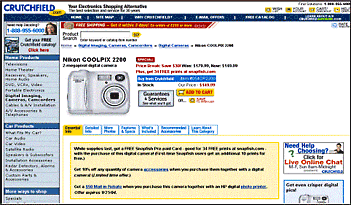
Crutchfield's product page layout uses tabs to organize everything a shopper might want to know about the item from essential info to recommended accessories.
Note the use of a limited time promotion to encourage accessory purchases: "Get 10% off any quantity of camera accessories when you purchase them together with a digital camera."
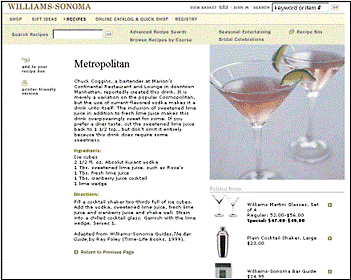
Williams-Sonoma, in an area of the site devoted to content, includes images and pricing of related items with links directly to product pages to facilitate buying everything needed to serve the offered recipe.
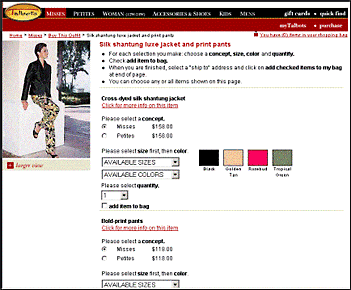
Talbot's "Buy this Outfit" feature enables customers to buy everything on the model—jacket, pants and shoes—from one page: "When you are finished select a ship to address and click on add checked items to my bag at end of page."
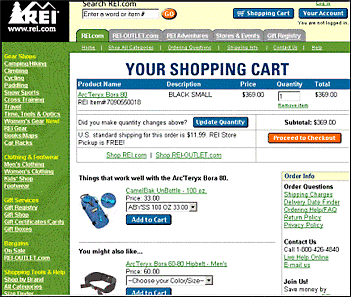
REI's Shopping Cart includes both "Things that will work well with…" and "You might also like…" , each populated will items relevant to the product being purchased that can easily be added to the order with a click on a highly visible "Add to Cart" prompt.
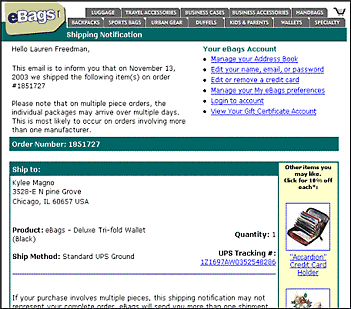
eBags' Shipping Notification Email is very comprehensive. One can actually shop from the menu tabs or manage their account via multiple links. There is a link to tracking track shipping and a column of related up-sells rounds out this well-branded communication.
About the Author
Lauren Freedman is author of It's Just Shopping and President of the e-tailing group, inc. whose mission is to leverage the art of merchandising to improve customers' multi-channel shopping experiences. Her book, a primer on the past, present and future of selling online, is available on the firm's website www.e-tailing.com or via Amazon. She can be reached at lf@e-tailing.com or by phone at 773-975-7280.