
Categories
- Channel Analytics
- Marketing Integration
- migration
- Omniture Business
- Online Marketing
- Online Merchandising
- Search Engine Marketing
- SEO
- Site Search
- social media
- Testing and Targeting
- Web 2.0
- Web analytics
Authors
- Adam Greco (46)
- Alex Hill
- Adam Justis (1)
- Brent Dykes (8)
- Ben Gaines (33)
- Brig Graff (2)
- Bret Gundersen
- Brian Hawkins (4)
- Brent Hieggelke (6)
- Bill Mungovan (14)
- Ben Robison (6)
- Brent Watson (1)
- Chad Greenleaf (2)
- Chris Knoch (4)
- Christopher Parkin (14)
- Christian Ridge (2)
- Chris Zaharias (6)
- David Kirschner (4)
- Ed Hewett (12)
- John Broady (10)
- Josh James (1)
- Jordan LeBaron (5)
- Jim McTiernan (2)
- Jeff Minich (9)
- Jose Santa Ana (2)
- Kiran Kairab Ferrandino (4)
- Kevin Lindsay (3)
- Matt Belkin (35)
- Mikel Chertudi (12)
- Michael Halbrook (4)
- Michael Klein (4)
- Matt Langie (5)
- Pearce Aurigemma (11)
- Siddharth Chaudhary (1)
- Steve Gustavson (3)
- Wes Funk (4)
Pages
Recent posts
- Summit Topic #3: Participation
- Summit Topic #2: getPercentPageViewed plug-in
- Summit Topic #1: Visitor Scoring in SiteCatalyst
- Welcome to the Idea Exchange!
- Dynamic Ad Targeting & Optimization Using Omniture Test&Target
- Mobile Video, App Targeting, and Flash 10.1, Oh My!
- Insight at Summit 2010 [Analysis with Insight]
- The Secret Revealed – New Solution Give Away (Advanced Solutions)
- Delivering Quick Wins: Score Early and Often - Part II
- Delivering Quick Wins: Score Early and Often - Part I
Recent comments
- Ben Gaines: Vitor, Great qu…
- Ben Gaines: Absolutely. Mayb…
- Ben Gaines: Glad you think s…
- HeatherA: The idea exchange …
- Ben Gaines: The labels could…
- Ben Gaines: Really glad to h…
- Jonathan Kay: Nice write-up …
- pamela: Hi just want to know…
- Vitor Lopes: Hi Ben, I ha…
- Ben Gaines: We tested this (…
Links
- DigitalAlex
- eMetrics (Jim Sterne)
- Forrester Research (John Lovett)
- Future Now’s grokdotcom
- immeria
- June Dershewitz on Web Analytics
- Lies, Damned Lies
- LunaMetrics
- Mine That Data
- Occam’s Razor
- Rich Page Ramblings
- SemAngel
- The Analytics Guru
- The Omni Man
- Web Analysis, Behavioral Targeting and Advertising
- Web Analytics World
Archives

The Elusive Web Measurement Strategy

Imagine taking a class in college without clearly knowing what is expected by your professor or how you will be graded. Nothing could be more stressful to a recovering “grade whore” like me. You could lean over to an intelligent-looking classmate beside you and ask their opinion of what is expected and how you will be graded. That’s not going to help you get the highest grade.
If you’re going to be successful in the class you really need to have a copy of the syllabus from the teacher. If you think back to your college days, a syllabus (that colored piece of paper that ended up crumpled at the bottom of your backpack by the end of the semester) was pretty important because it provided the course objectives, topics, and grading plan. With a syllabus in hand, any student has the potential to achieve an “A” in the class (mmmm “A”).
After emphasizing the need for an executive sponsor, my next key to creating a data-driven organization is aligning your implementation with business objectives. Many companies struggle with becoming more data-driven because they don’t have the equivalent of a “syllabus” for their online business. A web measurement strategy is a clear, cohesive strategy for measuring online business performance against business objectives. It encapsulates the organization’s current online business objectives and strategy, KPIs, and other unique reporting requirements.
In a recently released report by e-Consultancy, we continue to see that many companies still don’t have a measurement strategy in place. After surveying more than 800 digital marketers, e-Consultancy found “…that just one in five companies (22%) has an internal strategy that ‘ties data collection and analysis to business objectives’ and only 27% say their web analytics ‘definitely drive actionable insights.’”
Why do we need a measurement strategy?
In my opinion, there are four main benefits to developing a web measurement strategy:
- Gain a clearer understanding of your company’s online business performance. Without well-defined KPIs, you’re not going to truly understand business performance and take appropriate action.
- Achieve greater buy-in and adoption by involving key executives and stakeholders in the business requirements gathering phase.
- Align your organization around shared measurement objectives that are tied to key business goals. Having everyone focused on what’s most important to the business is extremely valuable.
- Avoid costly missteps that may require re-implementation and delay “time-to-value”. Measure twice, cut once.
Why are they so elusive?
In terms of managing a website, the pace of work hasn’t let up much since the late 1990’s. It’s a daily battle to keep the company’s website current in terms of content (e.g., products, articles, special promotions, campaigns, branding, etc.) and technology (e.g., video, social media, behavioral targeting, merchandising, testing, etc.). Being caught up in the day-to-day demands of managing one or more websites, many companies fail to set aside time to establish and communicate a clear online strategy for their web initiatives. It’s hard to form a web measurement strategy when there isn’t a clearly articulated web strategy to begin with.
At a successful high tech company, I met with 15-20 product marketing managers to discuss their business requirements. After some debate about what they wanted to measure online, the product marketing managers told me to ask senior management what their web strategy was and “let us know when you find out what it is.” Ouch. 
When approaching a new implementation project, managers who are tasked with managing the project can be tempted to dive right in and may feel a web measurement strategy isn’t necessary. They may feel they can sufficiently represent the “interests” of the business based on their internal conversations and insights. Unfortunately, this approach has led to situations where senior executives later complain that the produced web analytics reports do not reflect their actual business needs.
Similar to the children’s “telephone” game where a whispered message distorts as it passes from child to child, key business objectives can become equally distorted or misinterpreted as they are passed from VP-to-director-to-manager-to-analyst within an organization. Unless you go through the process of building a formal web measurement strategy, you may not fully understand the key requirements of your business.
Building a measurement strategy
Omniture Consulting has worked with various companies to help define their online measurement strategies, and I’ve identified three main stages in this process: Gather, Refine, and Align. The Gather stage typically involves several stakeholder interviews to better understand business goals and requirements (preferably face-to-face sessions). In the Refine stage, we evaluate, clarify, and prioritize objectives in order to develop a sound measurement strategy. In the Align stage, we share the new measurement strategy with the organization and then work towards aligning the implementation with key business objectives. 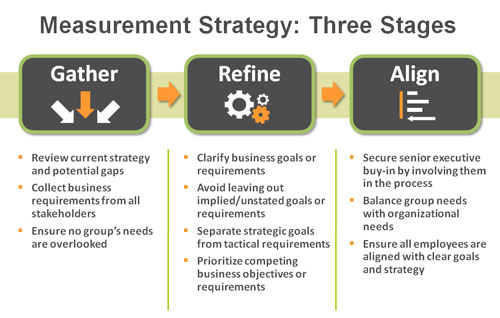
Is your overall business strategy static?
Probably not (or you may be touching up your resume if it is). Most successful companies will adapt online strategies to new market conditions to seize opportunities and avoid threats. For example, I imagine very few businesses have the same strategy today as they did two years ago.
However, many companies fail to re-calibrate their web measurement strategy and implementations when their business objectives have changed. These companies then wonder why their web analytics reports aren’t helping them to manage their online business. A German proverb states, “What’s the use of running if you are not on the right road.” What’s the use of tracking “metrics” if they don’t align with your business? Alignment is critical.
My next article in this series will focus on the importance of staffing and training.
Thanks Brent, I always enjoy these strategic posts. Very insightful and touching a point that many of us face on a daily basis. in this context I also recommend analysts to look at the SMART framework the Stephan Hamel is championing.
I’m glad that you enjoyed the post, Florian. Thanks for highlighting SMART objectives. That project mgmt framework can be very helpful in developing a sound measurement strategy.
In my experience, the measurement strategy often fails (or at least falls short of expectations) because the overall corporate/department/program strategy and objectives aren’t clear. I think that’s part of what you’re getting at here, but I would broaden the “Gather” phase a little bit to including gathering the key business objectives — not simply doing an assessment of the current measurement approach and strategy. Sadly (or happily, depending on how you look at it), this is sometimes where you get a quick and early win — bringing to light that the objectives of the department/program aren’t clearly articulated and agreed to (and, in the process, helping get that clarity). Without clear objectives to start with, any measurement strategy is going to fail!
You’re absolutely right, Tim . The “Gather” phase is all about understanding the key business objectives — I should have highlighted that more explicitly in the table. I try to be diplomatic when I ask for a company’s current measurement approach and strategy. It is VERY rare that a company is able to provide me with such a document. At that point, we turn the focus to identifying and agreeing on their key business objectives. As you’ve noted, it can be a great early win.