
Categories
- Channel Analytics
- Inside Discover
- Marketing Integration
- Migration
- Omniture Business
- Online Marketing
- Online Merchandising
- Search Engine Marketing
- SEO
- Site Search
- Social Media
- Testing and Targeting
- Web 2.0
- Web Analytics
Authors
- Aseem Chandra (2)
- Adam Egbert (3)
- Adam Greco (46)
- Alex Hill
- Adam Justis (1)
- Brent Dykes (27)
- Ben Gaines (46)
- Brig Graff (5)
- Bret Gundersen (2)
- Brian Hawkins (4)
- Brent Hieggelke (6)
- Bill Mungovan (16)
- Ben Robison (7)
- Brent Watson (5)
- Cameron Cowan (3)
- Chad Greenleaf (2)
- Chad Warren (1)
- Chris Knoch (4)
- Christopher Parkin (15)
- Christian Ridge (2)
- Customer Success (11)
- Chris Zaharias (6)
- David Kirschner (5)
- Ed Hewett (18)
- Jeremy Anderson (1)
- John Broady (10)
- Josh James (1)
- Jordan LeBaron (5)
- Jim McTiernan (2)
- Jeff Minich (9)
- Jose Santa Ana (2)
- Kiran Kairab Ferrandino (8)
- Kevin Lindsay (5)
- Kevin Willeitner (3)
- Laura MacTaggart (5)
- Matt Belkin (35)
- Mikel Chertudi (12)
- Michael Halbrook (7)
- Michael Klein (4)
- Matt Langie (6)
- Pearce Aurigemma (22)
- Ray Pun (1)
- Siddharth Chaudhary (2)
- Steve Gustavson (3)
- Steve Hammond
- Tim Lott
- Tim Waddell (3)
- Wes Funk (4)
Pages
Recent posts
- More info on the Summit Companion App and another chance to win a Motorola Xoom!
- Announcing Adobe SocialAnalytics: Blending Business with Social
- What’s Making Headlines at Summit 2011?
- Handheld HD Video Camera Giveaways at Summit and a chance to win a Motorola Xoom!
- The Adobe Omniture Summit Companion mobile app
- Some Helpful Summit Information
- Summit 2011: Tackling top industry issues at MindMeld
- Becoming Spider-Man:Testing Search Engine Traffic [Inside Adobe SiteCatalyst]
- Four Reasons to Attend the Web Governance Session at Adobe Summit 2011
- European Data Center Online
Recent comments
- Homes For Sale In Brentwood CA: You made your point and not much to discuss. It’s like t…
- Eco Med Supplies: Effective …
- order fulfillment: I have no…
- Barcodes Software: Again you…
- Joe Corbett: Love it!
- Shoes: I lnow you can get th…
- Shoes: This article is truly…
- Ed Hewett: Dave-to clarify, …
- Ed Hewett: Andreas--the valu…
- H and A Admissions Consulting: The author has written an excellent article. You made you…
Links
- DigitalAlex
- eMetrics (Jim Sterne)
- Forrester Research (John Lovett)
- Future Now’s grokdotcom
- immeria
- June Dershewitz on Web Analytics
- Lies, Damned Lies
- LunaMetrics
- Mine That Data
- Occam’s Razor
- Rich Page Ramblings
- SemAngel
- The Analytics Guru
- The Omni Man
- Web Analysis, Behavioral Targeting and Advertising
- Web Analytics World
Archives

Do Mobile-optimized Experiences Improve Engagement on “Super” Phones and Tablets like the iPad?
I recently researched the impact of mobile-optimized experiences on mobile visitor engagement. To compare mobile usage between the “mobile optimized” and “standard” versions of a web property, I calculated key engagements per visit on both the standard and mobile websites for 15+ popular devices including the Apple iPhone, Motorola Droid, HTC Nexus One, Palm Pre, BlackBerry Storm 2, and Nokia N97. I also analyzed impact on the iPad which I’ve detailed at the bottom of this post.
Tip: For your own analysis you should use a engagement or conversion metric that drives revenue for your business—ad views or page views for media companies, revenue for retailers, etc. You should also ensure you are accurately identifying mobile visits and visitors. CNAME/First Party Cookie implementations are a must here—for more info, read Top 5 Mobile Implementation Gotchas.
Provide Mobile-Optimized Experiences for Mobile Users
The results of my analysis shouldn’t surprise you—mobile-optimized experiences produced an average 75% higher rate of engagements per visit for mobile users. Such significant improvements in engagement for mobile visitors help justify investment in mobile-optimized channels but it’s only the first step.
Fix Trouble Spots in Mobile Channels
Now you’re feeling good about the gains from providing a mobile-optimized experience, it’s time to make additional improvements. Comparing total engagements per visit for both your standard site and your mobile site (or app) will help you discover break points in the mobile experience. For the data set I analyzed, total engagements per visit were 20% lower for the mobile site than for the standard site. The gap represents a significant opportunity to improve the user experience on the mobile site and create real gains in engagement and conversion. By drilling one level deeper to specific steps in your key engagement or conversion process, you can discover user drop off points.
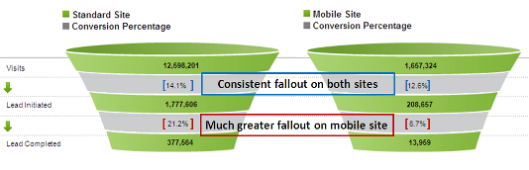
In the mock-up data above, nearly the same percentage of total site visits result in a “lead initiation” for the standard and mobile sites but fallout between initiation and completion is much greater for the mobile site. In this example, fine tuning the lead initiation page on the mobile optimized site so it converts as well as the same page on the standard site could increase mobile leads completed by 3X!
Target Experiences to Specific Devices Where Appropriate
By creating mobile optimized channels for your customers and then fine tuning those experiences, you can produce very substantial improvements in engagement in conversion; but what happens when a new category of device is thrown into the mix? A lot of marketers are considering how to handle new tablet devices like the Apple iPad or the HP Slate. Marketers are asking questions like, “should iPad visitors receive the standard site, the mobile-optimized site, or a third flavor customized for tablets?”
The answer to this question and others will vary depending on business model, industry, and many other factors; however, these types of business decisions should be driven by analytics. For fun, I included visits from iPad users in the dataset I analyzed to determine the uplift produced from mobile-optimized experiences. The results of my analysis may surprise you—mobile-optimized experiences produced an average 15% lower rate of engagements per visit for iPad users. For this particular set of data, the customer would be better not redirecting iPad users to the mobile version of the site.
While the dataset produced by visitors using an iPad was small and ultimately may not represent the population after launch, engagement and conversion metrics for the iPad and other tablet devices should be closely monitored to ensure users are receiving an optimal experience. By targeting specific experiences to specific devices like the iPad, you may be able to attain an additional increase to key user actions.
Here’s some additional resources you can leverage to analyze the impact of the iPad on your online initiatives.
Sample iPad User Agent—useful for updating mobile site redirection rules:
Mozilla/5.0 (iPad; U; CPU iPhone OS 3_2 like Mac OS X; en-us) AppleWebKit/531.21.10 (KHTML, like Gecko) Version/4.0.4 Mobile/7B317 Safari/531.21.10
iPad Analytics Support—Omniture provides both measurement and reporting support for the iPad: iPad App Measurement & iPad Mobile Device Reporting (press release)
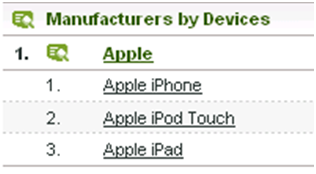
iPad SiteCatalyst App—updated version of the app optimized for the iPad:SiteCatalyst App for iPhone, iPod Touch, and iPad (Version 1.2)
Homework assignment—browse to the mobile reports in your SiteCatalyst reporting environment and search for “iPad” to see if anyone with a “pre-release” device has visited your websites or apps.
Ed- this is very interesting however it would be helpful to better understand your methodology. First you state that mobile-optimized experiences average 75% higher rate of engagements per visit for mobile users. But the next paragraph states “For the data set I analyzed, total engagements per visit were 20% lower for the mobile site”.
Dave-to clarify, mobile users are more engaged when they receive mobile-optimized experiences than when they receive a standard desktop experience. However, mobile users still have lower engagement rates when compared to desktop users. This demonstrates two things:
(1) providing mobile optimized experiences is good
(2) there’s still lots of room to improve mobile optimized experiences (of course analytics play an important role in identifying trouble spots, etc.)